
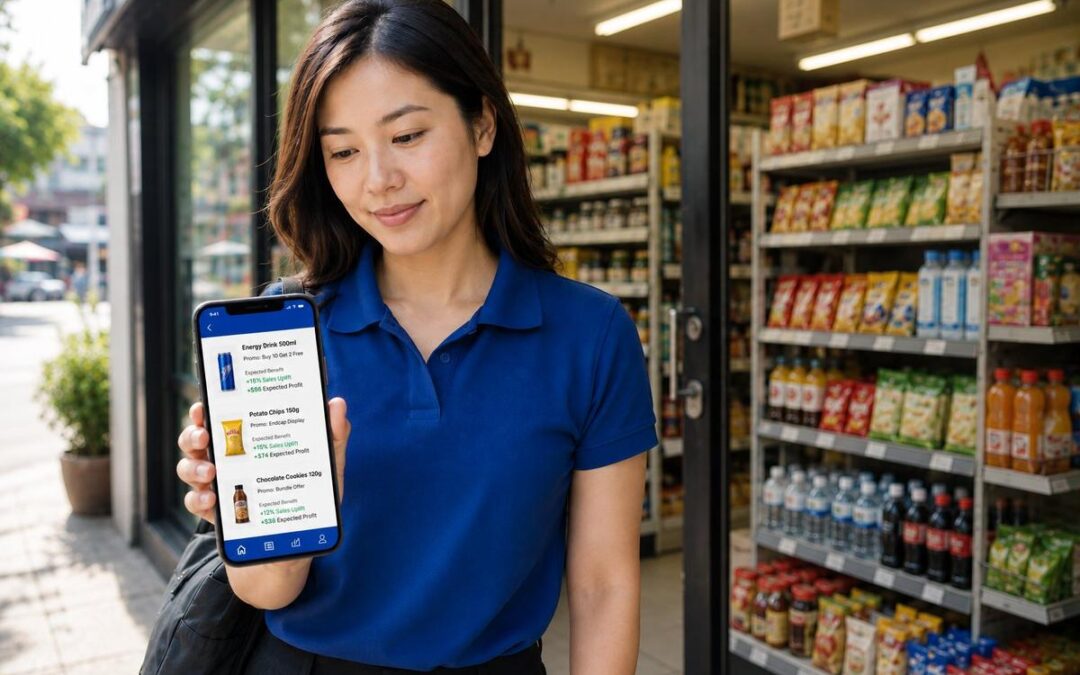
AI Sales Pitch for CPG: How AI Stories Lift Sell-In
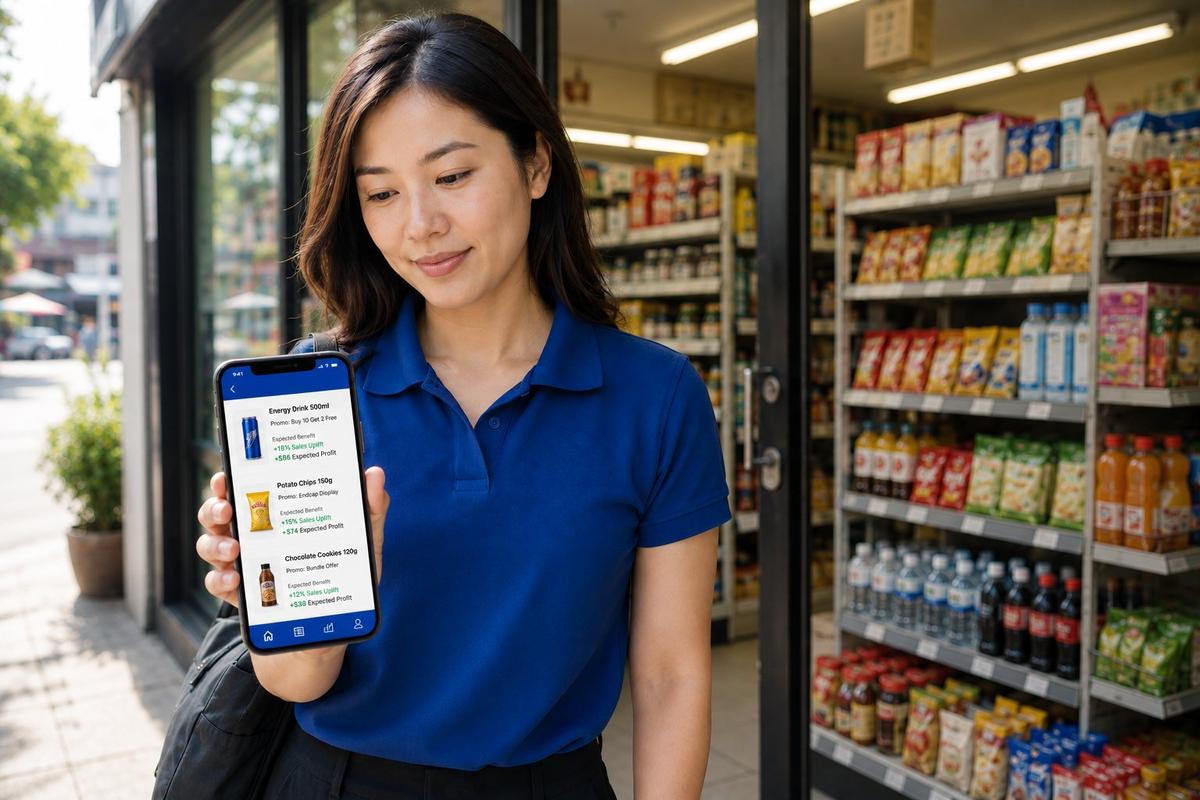
A rep walks into a store. The buyer is busy. There is maybe ninety seconds to make the case for a new SKU, a promotion, or more shelf space. What the rep says in that window — and how they say it — decides the order. Yet most consumer-goods teams still leave that moment to memory, habit, and whatever the rep picked up last quarter. That gap is exactly where AI sales pitch generation for CPG changes the math.
eBest’s AI Selling Story turns store profiles, local best-sellers, promotion calendars, and category data into a tailored, store-specific talk-track a rep can use the moment they walk in. It is the “how to say it” side of sell-in — what a rep actually says in the ninety seconds that matter — and it is the part generic order automation was never built to handle.
The shift is already underway. Analyst firms such as Gartner and McKinsey now frame AI-augmented selling and route-to-market execution as a core CPG capability area for the decade ahead — yet most vendor roadmaps still stop at the order line.
What “AI Sales Pitch” Actually Means
An AI sales pitch in CPG is not a chatbot. It is a capability that reads everything the system already knows about a store — its size, its assortment, what sells locally, what promotion is live this week, what the competitor is doing next door — and writes a short, practical pitch a real person can deliver out loud.
The output is a talk-track, not a report. It tells the rep: open with this, lead with this SKU for this store, handle the obvious objection this way, close with this ask. Different store, different story. The same rep who struggles in an unfamiliar outlet suddenly sounds like a local expert.
Selection vs Pitch — Two Capabilities, Not One
It helps to separate two things that often get bundled under “AI for sell-in”:
- What to sell — which SKUs, which cross-sell, which basket to push. That is the territory of *AI sell-in suggestion*, which eBest also ships (covered in our piece on AI sell-in suggestion).
- How to say it — the words, the order, the objection handling, the local angle. That is *AI Selling Story*, this article’s focus.
Both improve sell-in. They are complementary, not redundant. A rep who knows the right SKU but freezes on the pitch still loses the order. A rep with a great story for the wrong product loses it too. eBest wires both into the same sales force automation flow so the suggestion and the story arrive together, at the right store, at the right time.
The Real Cost of “Winging It”
The cost is not abstract. Retail-execution research from NielsenIQ consistently points to in-store execution — not the product catalogue — as the deciding factor at the shelf.
When pitch quality depends on individual experience, three problems show up predictably:
- New reps underperform for months. They have the product list but not the judgment of which angle works in which store. Ramp time stretches.
- Stories drift from headquarters’ intent. A pitch that tested well in one region mutates as it passes person to person, until the field is saying things no one approved.
- Good plays don’t travel. The top performer in Region A has a killer approach for convenience stores; nobody in Region B ever hears it.
Generic “order AI” makes the transaction smoother but does nothing for any of this. It optimizes *the order line*, not *the conversation*. For sales leaders, that is the difference between a tool that saves clicks and a tool that moves revenue.
How eBest’s AI Selling Story Works
The engine sits on the same data loop that powers the rest of the route-to-market suite — SFA, DMS, TPM, and DSD feeding one model of each store:
- Store profile from SFA history: size, channel, past orders, category mix.
- Local demand from DMS and POS signals: what actually sells in this neighborhood.
- Live context from TPM: which promotion, display, or price is active this week.
- Competitive signals: what rival brands are doing nearby.
The model composes a pitch from those inputs — short enough to deliver in a real visit, specific enough to sound local. A rep can ask it to shorten, soften, or focus on margin; the story re-adjusts. The rep stays in control; the system removes the blank-page problem.
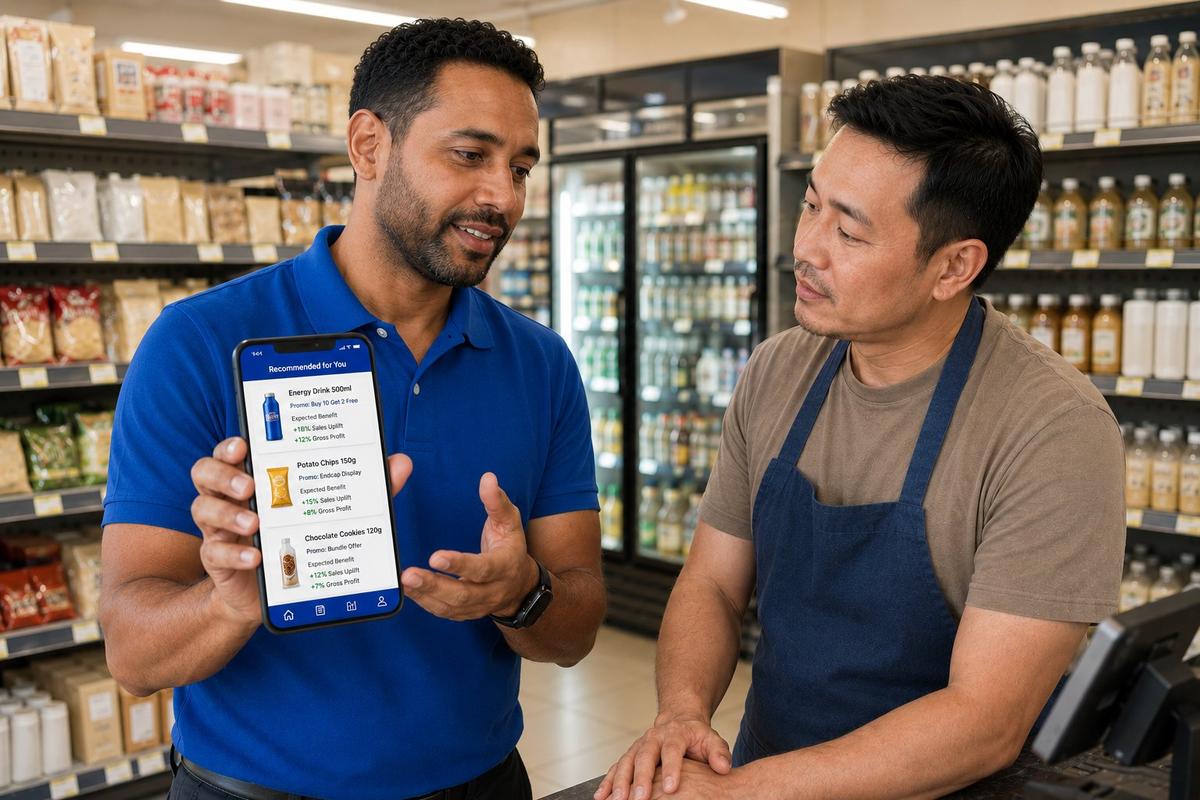
A Rep’s Day, With the AI Sales Pitch Built In
Picture the rhythm once AI Selling Story is live:
- Morning plan: the day’s route loads with a one-line story hook per store, so the rep arrives knowing the angle.
- Before the visit: tapping a store pulls a full talk-track — open, lead SKU, objection handling, close.
- During the visit: the rep adapts on the fly; the same model can suggest a counter to a live objection (“they say shelf space is full” → “lead with the rotational display angle”).
- After the visit: the outcome feeds back, so the next store’s story is sharper.
This is the same “covers the rep’s full day, not a slice” principle behind agentic AI for CPG — but aimed squarely at the selling conversation rather than the back-office steps.
Why Generic Platforms Can’t Do This
Most “AI for sales” in CPG stops at predictive ordering or smart replenishment. Those are useful. They are also backward-looking: they optimize what was ordered. A pitch is forward-looking — it has to persuade a human in real time, in a specific store, against a specific competitor.
eBest’s edge is that the model is trained on CPG route-to-market data, not bolted onto a generic Large Language Model. It knows the difference between a hypermarket key account and a corner shop, and it writes accordingly. That is why SalesCode-style “smart order” and BeatRoute-style “promo co-pilot” tools — strong on the order, silent on the pitch — leave this layer uncovered.
What Sales Leaders and IT Actually Get
For a Sales Director, the headline is ramp time and consistency: new reps sound competent faster, and every store hears a story aligned with brand strategy. For a Sales Enablement Lead, it is finally a way to scale the best plays across regions without relying on hallway knowledge.
For IT, the integration story is the same as the rest of the platform: it runs on the existing SFA and RTM stack, data stays in your environment, and the underlying model can run on a default foundation model or your own — no separate AI vendor to onboard.
Where to Start
You do not need a twelve-month transformation. Pick one product line or one region, load the store profiles already in SFA, and let AI Selling Story generate pitches for a defined set of visit types. Measure pitch consistency and early sell-in lift over four to eight weeks, then expand. The capability is built in — the work is scoping the pilot, not building the model.
FAQ
What is an AI sales pitch generator for CPG?
It is a capability that reads a store’s profile, local demand, and active promotions, then writes a short, store-specific talk-track a field rep can deliver during a visit — the “how to say it” side of sell-in.
How is it different from AI sell-in suggestion?
Sell-in suggestion answers *what to sell* (which SKUs or cross-sell). AI Selling Story answers *how to say it* (the pitch and objection handling). They are complementary and often used together.
Does this replace the rep?
No. The rep stays in control of the conversation. The system removes the blank-page problem and keeps the story aligned with brand strategy; the human delivers it and adapts live.
Is our store data safe?
Yes. The capability runs on the existing SFA/RTM stack, data stays in your environment, and the model can use a default foundation model or your own private model.
Which teams benefit most?
Sales Directors (shorter ramp, consistent messaging), Sales Enablement (scaling best plays), and IT (native integration, no extra AI vendor).
*See how the full agentic AI for CPG stack turns store data into daily execution — and where AI Selling Story fits inside it.*
Ready to Digitize Your Route to Market?
Learn how eBest’s integrated SFA, DMS, and TPM platform helps leading CPG brands turn distribution data into competitive advantage.