
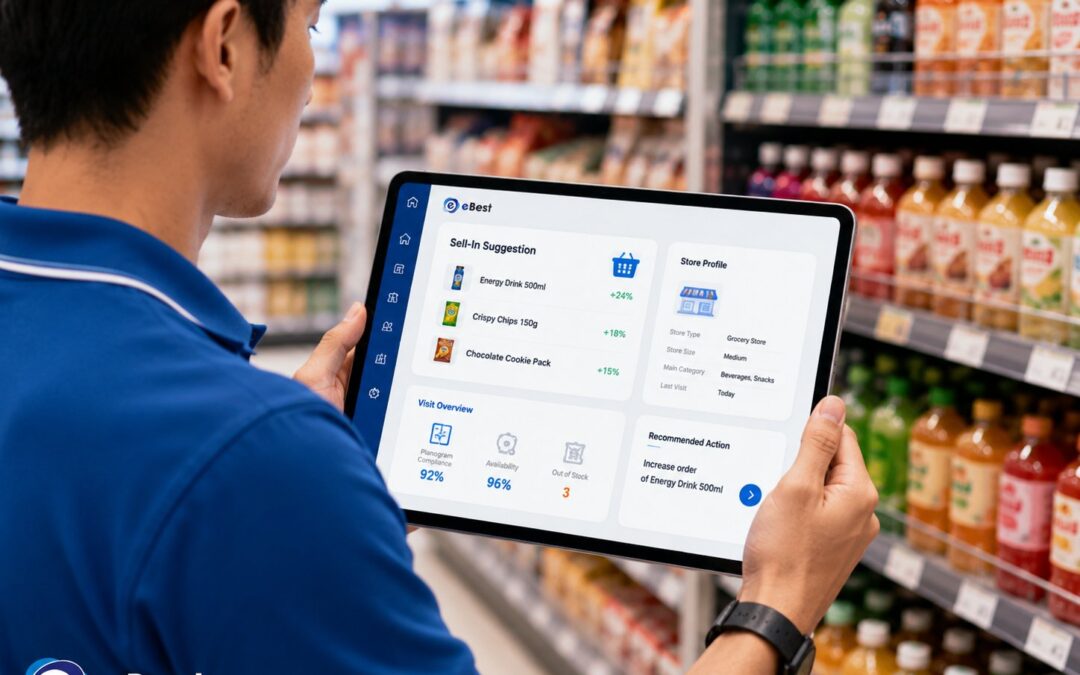
AI Sell-In Suggestion: What It Is and Why CPG Needs It
A rep walks into a convenience store with 90 seconds and a full cart. She could push the hero SKU and leave — or she could lift the basket with the one secondary item that outlet actually moves. That second move is exactly what AI sell-in suggestion is built for. It’s a CPG capability that reads a store’s profile, assortment, perfect-store compliance, and route history, then hands the rep a specific cross-sell or bundle to pitch at the shelf. The recommendation is grounded in real execution, not a generic reorder button. eBest delivers this through its AI Selling Story engine, turning store-visit data into revenue while the rep is still standing in the aisle.
Why CPG Companies Need AI Sell-In Suggestion
Most CPG revenue is won or lost at the shelf, not in a headquarters forecast. Yet field teams walk past cross-sell opportunities every single day because nothing tells them what to do next. Traditional ordering tools were designed to replenish, not to grow — they’ll tell a rep how many cases of the hero SKU to ship, but they stay quiet on the secondary item, the new flavor, or the promo bundle that could lift the basket. So cross-sell ends up depending on a rep’s memory and mood, which means it varies wildly across thousands of outlets.
AI sell-in suggestion fixes that by connecting execution data to a single, timely recommendation. Because it reads the store’s profile, local best-sellers, and current perfect-store compliance, it can name the one action that matters for that outlet. The rep stops scanning a catalog and starts acting on a prioritized, store-specific suggestion with a reason attached.
Here’s the behavioral shift that matters most: when a recommendation is generic, reps skip it; when it’s relevant and explained, they act. Gartner projects agentic-AI supply-chain software spend to climb from $2 billion in 2025 to $53 billion by 2030, with sell-in intelligence among the defining breakouts — a signal that CPG leaders such as Swire Coca-Cola and Nestlé now treat sell-in suggestion as a frontline capability rather than a reporting afterthought. The brands that deploy AI sell-in suggestion convert store-visit data into incremental revenue; the ones still on generic ordering leave that revenue sitting on the shelf.
How does AI sell-in suggestion actually reduce lost cross-sell at the shelf?
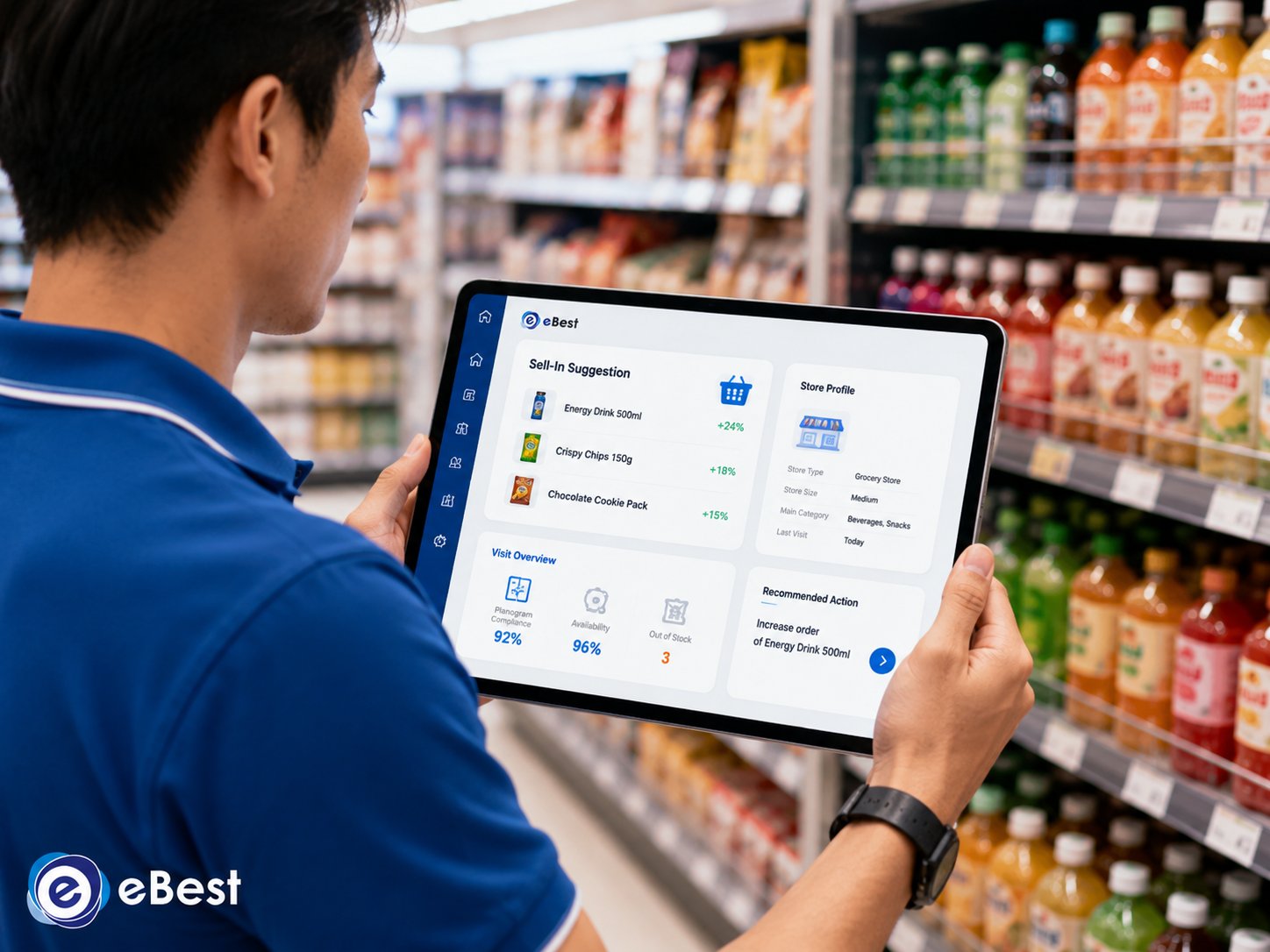
The honest answer: it moves the recommendation to the moment of decision. The engine evaluates an outlet’s profile, recent assortment, and local best-sellers, then surfaces a targeted secondary SKU, bundle, or display — during the visit, not after the store door closes.
Picture a beverage rep at a convenience store. Instead of recalling last month’s promo, she sees a prompt to add a limited-edition SKU that’s already selling well in nearby outlets, with a short talking point attached. She doesn’t have to guess what fits; the system hands over a store-specific action and the reason behind it.
Relevance is what drives follow-through. When a suggestion is explainable and grounded in that store’s data, reps trust it and retailers accept it. Lost cross-sell drops because the right item is offered at the right store at the right time — and managers finally get visibility into which suggestions actually convert. That’s how AI sell-in suggestion turns cross-sell from a hope into a measured, coachable process.
How AI Sell-In Suggestion Works in the CPG Route to Market
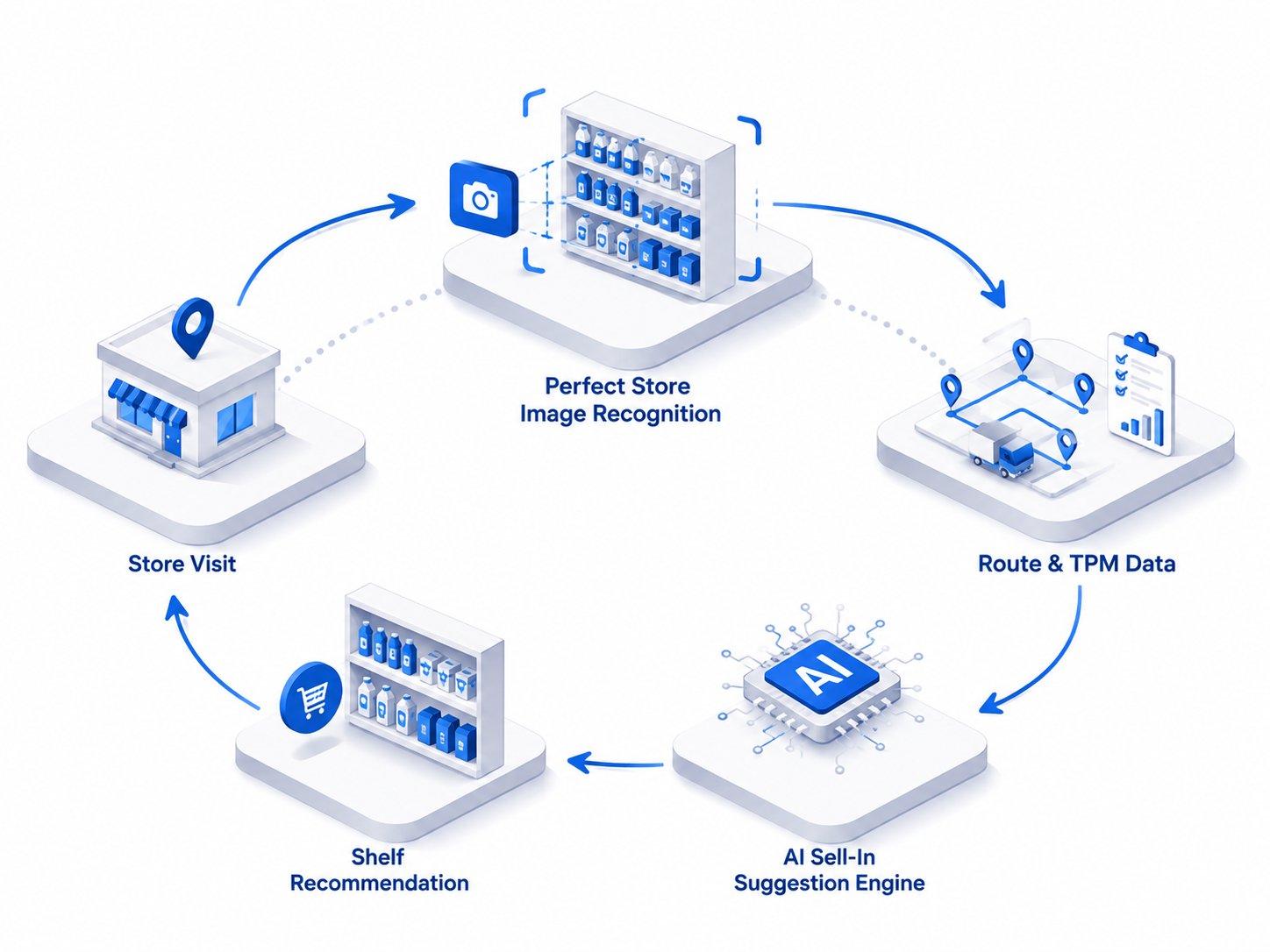
An AI sell-in suggestion is only as good as the data loop behind it. The capability sits where route-to-market execution meets trade promotion, turning field data into a revenue action. The loop starts with a store visit captured in sales force automation software, where the rep records assortment, photos, and orders. That execution data then flows into the recommendation engine.
From there, perfect-store signals — shelf share, facings, POSM, and special displays — give the ground truth of what’s actually on the shelf. Meanwhile, distributor management system data shows what each outlet can realistically stock, and trade promotion management software supplies the active promotion calendar. Route history adds visit frequency and seasonal patterns. When those streams combine, the model recommends a SKU-level sell-in action that fits both the store and the live promotion.
What data actually powers an AI sell-in suggestion engine?
Four connected sources, each adding a layer of relevance. First, store-profile data — size, channel, historical assortment — sets the baseline. Second, local best-seller signals from nearby outlets reveal demand the current store may be missing. Third, perfect-store execution data, captured through perfect store image recognition, confirms what’s physically present versus what was planned. Fourth, promotion and route data align the suggestion with what’s funded and when the rep returns.
NielsenIQ retail execution research underscores that assortment relevance and shelf compliance — more than price alone — drive incremental cross-sell at the shelf. Because these sources are unified rather than siloed, the suggestion is both relevant and feasible. Recommending a chilled SKU to a store without cold-chain access would be useless; the DMS layer quietly prevents that error, and the promotion layer makes sure the suggestion rides active trade spend instead of fighting it. That’s why unified data, not a clever algorithm, is the real differentiator behind AI sell-in suggestion.
How to Choose AI Sell-In Suggestion Software for CPG
McKinsey CPG research is blunt about this: unified route-to-market data — not isolated point tools — is what lets AI translate execution into revenue. So when you’re evaluating vendors, look past the “AI” label and ask two questions: what data does the system actually use, and what action does it produce? A true AI sell-in suggestion platform must be grounded in execution data, not just historical orders.
| Dimension | Generic predictive ordering | AI sell-in suggestion (eBest) |
|---|---|---|
| Data foundation | Historical orders only | Perfect-store + route + TPM + assortment |
| Recommendation type | Replenishment quantities | SKU-level cross-sell, bundles, displays |
| Shelf grounding | None | Perfect store image recognition |
| Rep enablement | Order entry | AI Selling Story talking points |
| Manager view | Order reports | AI Chat Report + AI KPI Suggestion |
Beyond the table, the platform should plug into your existing SFA, DMS, and TPM rather than forcing a separate system. It should also explain its suggestions so reps and managers trust them. When you’re comparing options, prioritize unified data, explainability, and rep enablement over a black-box score you can’t question.
How AI sell-in suggestion powers store-profile cross-sell
The core of eBest’s approach is the named AI Selling Story engine. During a visit, it recommends products to pitch based on the store’s profile and local best-sellers, then generates a sales pitch the rep can use on the spot. Because the suggestion is store-specific, it reads as helpful rather than scripted — reps lift cross-sell without memorizing catalogs.
Why perfect-store grounding matters inside AI sell-in suggestion
A suggestion is only worth something if the shelf can support it. eBest’s perfect store image recognition captures shelf share, facings, POSM, and special displays from a single photo, so the AI sell-in suggestion engine knows what’s actually present before it recommends the next item. That grounding kills impossible asks and keeps the suggestion aligned with real execution.
How managers see ROI from AI sell-in suggestion
Leaders need to know which suggestions convert. eBest’s AI Chat Report lets managers ask plain-language questions and get instant insight reports, while AI KPI Suggestion diagnoses performance and proposes coaching actions. So AI sell-in suggestion becomes a managed loop — visit, recognize, recommend, sell, learn — instead of a one-time prompt nobody reviews.
How eBest Solves This
eBest doesn’t bolt AI sell-in suggestion onto a single module; it threads the capability through the whole route-to-market chain. The engine draws on AI Selling Story for store-specific pitches, perfect store image recognition for shelf grounding, and AI Chat Report plus AI KPI Suggestion for manager visibility. Because those capabilities share one unified SFA, DMS, TPM, and DSD data layer, the recommendation is both relevant and executable at the shelf.
In production, eBest serves leading CPG brands. Nestlé uses hyper-personalized cross-sell at shelf through AI suggestion; Swire Coca-Cola applies sell-in suggestions to drive perfect-store compliance and outlet-level assortment. Those are qualitative proof points, not modeled percentages — the kind of frontline behavior shift you can see on a rep’s tablet. eBest’s CPG customer success stories show how unified execution data turns into measurable selling habits. The approach treats AI sell-in suggestion as a revenue loop rather than a standalone ordering add-on.
How to Deploy AI Sell-In Suggestion (Step by Step)
Rolling this out follows a practical, phased path built on data you already collect — no rip-and-replace required.
- Connect your execution data — Integrate SFA, DMS, and TPM so store visits, assortment, and promotions share one layer; without unified data the suggestions will be generic.
- Enable perfect-store capture — Turn on perfect store image recognition so the engine knows what is physically on the shelf before it recommends the next SKU.
- Activate the AI Selling Story engine — Push store-profile cross-sell and talking points to reps at the visit, with a reason attached to each suggestion.
- Coach with AI Chat Report and AI KPI Suggestion — Give managers plain-language analytics to see which suggestions convert and where to coach.
- Iterate the loop — Review converted versus skipped suggestions monthly and tune the model so recommendations grow more relevant over time.
Frequently Asked Questions
Q1: What is AI sell-in suggestion and how is it different from predictive ordering?
A: AI sell-in suggestion is a CPG capability that analyzes unified perfect-store, route, and promotion data to recommend personalized cross-sell and basket actions at the point of sale. Predictive ordering, by contrast, typically uses only historical orders to calculate replenishment quantities. The key difference is intent: predictive ordering keeps the shelf stocked, while AI sell-in suggestion grows the basket with SKU-level cross-sell, bundles, and displays. Because it’s grounded in real execution data through capabilities like perfect store image recognition, the suggestion fits that specific outlet — so reps act on it during the visit, not after. That’s why CPG leaders treat sell-in suggestion as a revenue tool, not just an ordering helper.
Q2: How long does it take to implement AI sell-in suggestion for a CPG brand?
A: It depends on how unified your route-to-market data already is. If your SFA, DMS, and TPM share a common data layer, enabling AI sell-in suggestion is mostly configuration and training rather than a rebuild. Most teams pilot on a defined channel or region, then expand once reps adopt the suggestions. The fastest wins come from activating the AI Selling Story engine on top of existing store-visit data and perfect-store capture. Because the capability rides your current execution workflow, reps don’t need new tools — just a smarter prompt at the shelf. A focused rollout can show behavioral change quickly, with broader coverage following as trust in the suggestions grows.
Q3: Which eBest AI capabilities power the sell-in suggestion feature?
A: eBest’s AI sell-in suggestion is powered by several named capabilities. The AI Selling Story engine recommends products to pitch and generates a store-specific sales pitch during the visit. Perfect store image recognition provides the shelf ground truth — facings, shelf share, POSM, special displays — so suggestions fit what’s actually present. AI Chat Report gives managers plain-language, Text-to-SQL insight into which suggestions convert, and AI KPI Suggestion proposes coaching actions to lift performance. Together they form a loop from visit to recommendation to revenue on one unified SFA, DMS, TPM, and DSD platform. That named, scene-specific design is what makes eBest’s approach concrete instead of a vague “AI-powered” claim.
Q4: Can AI sell-in suggestion work for beverage, dairy, and other CPG segments?
A: Yes. AI sell-in suggestion is segment-agnostic because it learns from each outlet’s profile, local best-sellers, and execution data rather than a fixed rule set. In beverages, it can promote a limited-edition SKU or a multipack bundle at convenience stores; in dairy, it can balance ambient and chilled assortment by store type. Because the engine respects distributor and cold-chain constraints from the DMS layer, it won’t suggest items a store can’t stock. And promotion calendars from TPM keep suggestions aligned with active trade spend across segments. So the same capability serves food, personal care, and home-care brands by adapting to local demand instead of applying one generic order rule.
Q5: How do I choose between AI sell-in suggestion tools as a CPG leader?
A: Start by asking what data the tool actually uses and what action it produces, because those two factors determine the value. Prefer a platform that unifies perfect-store, route, and promotion data over one that relies on historical orders alone. Check whether it explains its suggestions and enables reps with talking points, not just a score. Evaluate integration with your existing SFA, DMS, and TPM to avoid a disconnected silo. And confirm manager analytics exist so you can measure conversion and coach. A capable AI sell-in suggestion tool should name its underlying capabilities — such as AI Selling Story and perfect store image recognition — rather than hiding behind a generic “AI” label.
AI sell-in suggestion is the difference between a rep who reorders and a rep who grows the basket — and that difference shows up in revenue the moment it reaches the shelf. It turns unified perfect-store, route, and promotion data into a specific, explainable action a rep can take while the visit is still happening. eBest delivers it through named capabilities — AI Selling Story, perfect store image recognition, AI Chat Report — on one platform, not a bolt-on. The brands pulling ahead at the shelf aren’t the ones with the biggest catalogs; they’re the ones giving reps the next right move. That move is one capability inside the wider shift to agentic AI for CPG sales, where the assistant plans the visit, builds the pitch, and verifies the shelf. Want to see it on a real rep tablet? Book a demo and we’ll walk your route-to-market data through the loop.
Ready to Digitize Your Route to Market?
Learn how eBest’s integrated SFA, DMS, and TPM platform helps leading CPG brands turn distribution data into competitive advantage.