
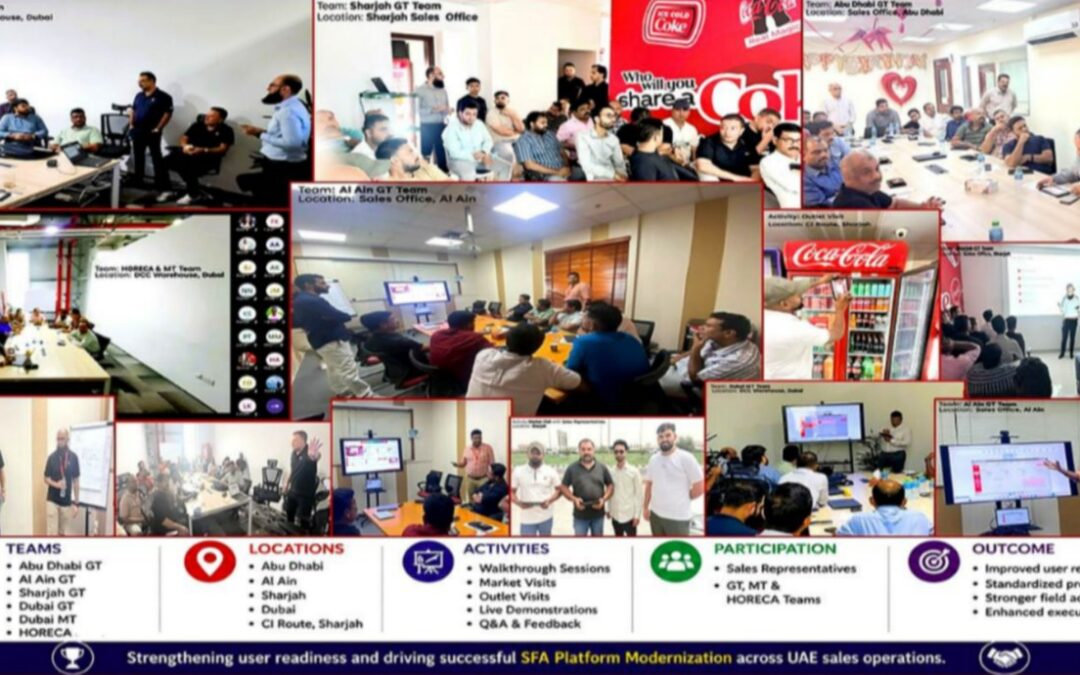
Coca-Cola UAE SFA Goes Live: 100% Day-One Activation
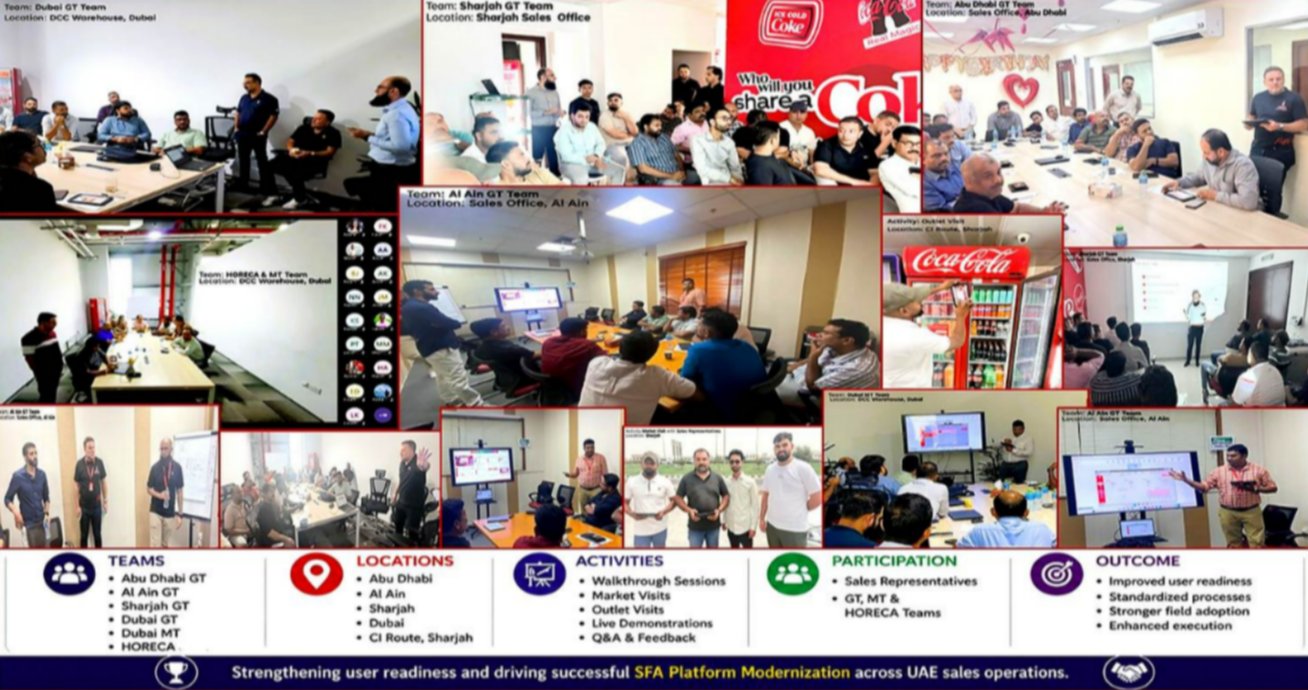
Day one. 100% of the UAE field force activated. Not three channel teams — six. Abu Dhabi GT, Al Ain GT, Sharjah GT, Dubai GT, Dubai MT, and HORECA. Not one city — four. Abu Dhabi, Al Ain, Sharjah, and Dubai. All six sub-teams across all four cities signed in, all started using the new SFA, and all hit the same SKU search and order screens before lunch. That is the result we want to talk about, and it is not because the app is beautiful. It is because three predictable frictions were removed before a single rep logged in.
This is what the Coca-Cola UAE SFA launch actually looked like — and what other CPG field organizations can steal from it.
How the Readiness Was Built (Before the App Went Live)
The 100% day-one number is the headline, but the work happened in the two weeks before. The UAE team ran a structured readiness program that touched every sub-team in every city, in person, with the actual app. The activities fell into five patterns:
- Walkthrough sessions — every supervisor and senior rep walked through the new SFA flow end-to-end, with the UAE team watching, taking notes, and re-coding where the flow broke.
- Market visits — small groups of reps went to live outlets in their own territory and ran the new order and visit flow on real shelves. The friction showed up in the field, not in the demo room.
- Outlet visits — for the HORECA and MT teams, the UAE team sat in on actual account visits to see how the new dashboards and SKU search behaved under real conversation pressure.
- Live demonstrations — every cohort saw the SFA app running on a real screen, with the UAE team pointing through the exact flows each sub-team would use the next morning.
- Q&A and feedback — every session closed with structured feedback, which the UAE team rolled back into the build the same day.
That feedback loop is why the activation number landed where it did. The app was already broken in — by the people who would use it on day one.
The visible outcome of the readiness program showed up in the same place: improved user readiness, standardized processes across sub-teams, stronger field adoption, and a single execution view that supervisors could actually read.
What It Took to Hit 100% Day-One Activation
Most SFA rollouts land somewhere between 40% and 70% activation in the first week. The remaining 30%–60% either never log in, log in once and drop off, or log in but keep working the old way. The pattern is so consistent that “adoption” has become a multi-quarter program in most CPG IT plans — a pattern McKinsey’s route-to-market research flags as one of the biggest drags on CPG productivity in 2026.
The UAE team refused to accept that pattern. The launch playbook came down to three friction removals, and every one of them was designed before the app went live — not patched in after.
1. Voice + Barcode Search Replaced Three Tabs of Menus
A field rep is standing in front of a shelf. The buyer has asked for a specific SKU the rep did not order last week. The old answer was: open the search menu, scroll through category → brand → pack size, and type the SKU. Twenty seconds. Long enough to break eye contact, long enough to lose the moment.
The new answer is one of two — say the SKU out loud, or scan the barcode on the can. The product opens in under a second. No menu. No category drilldown. The rep stays in the conversation.
This is the barcode and voice product search pattern that has been on the UAE team’s wish list for two cycles. It is the kind of capability that is invisible to a buyer but transformative for a rep — the difference between a tool that interrupts the visit and a tool that disappears into it.
2. Must-Have SKUs Were Surfaced Inside the Call, Not Buried in a Report
A real CPG visit does not have time for a rep to open a separate report, navigate to “recommendations,” and decide what to pitch. By the time the rep has done that, the conversation has moved on.
The UAE team took a different approach. When a rep opens a store in the new SFA, the system already shows the must-have SKUs for that channel, that neighborhood, and that day. The recommendation sits in the call screen, next to the order line. It is part of the visit, not a separate workstream.
This is the same logic behind eBest’s AI sell-in suggestion — a capability that reads the store profile, local demand, and live promotion calendar, and surfaces the right SKU at the right moment. The UAE team did not wait for a “full AI” rollout. They got the must-have SKU visibility in front of reps on day one, with the AI refinement running in the background.
3. Color-Coded Dashboards a Supervisor Reads in 10 Seconds
A regional sales manager for a Gulf bottler has maybe 90 seconds between calls to glance at the screen. The old dashboard was a grid: store count, visit count, order value, SKU count, plus a long tail of filters. Useful, but slow.
The new dashboard is color-coded by default. Red stores need attention today. Yellow stores are on plan. Green stores are done. A supervisor reads the whole region in under ten seconds and knows exactly where to focus.
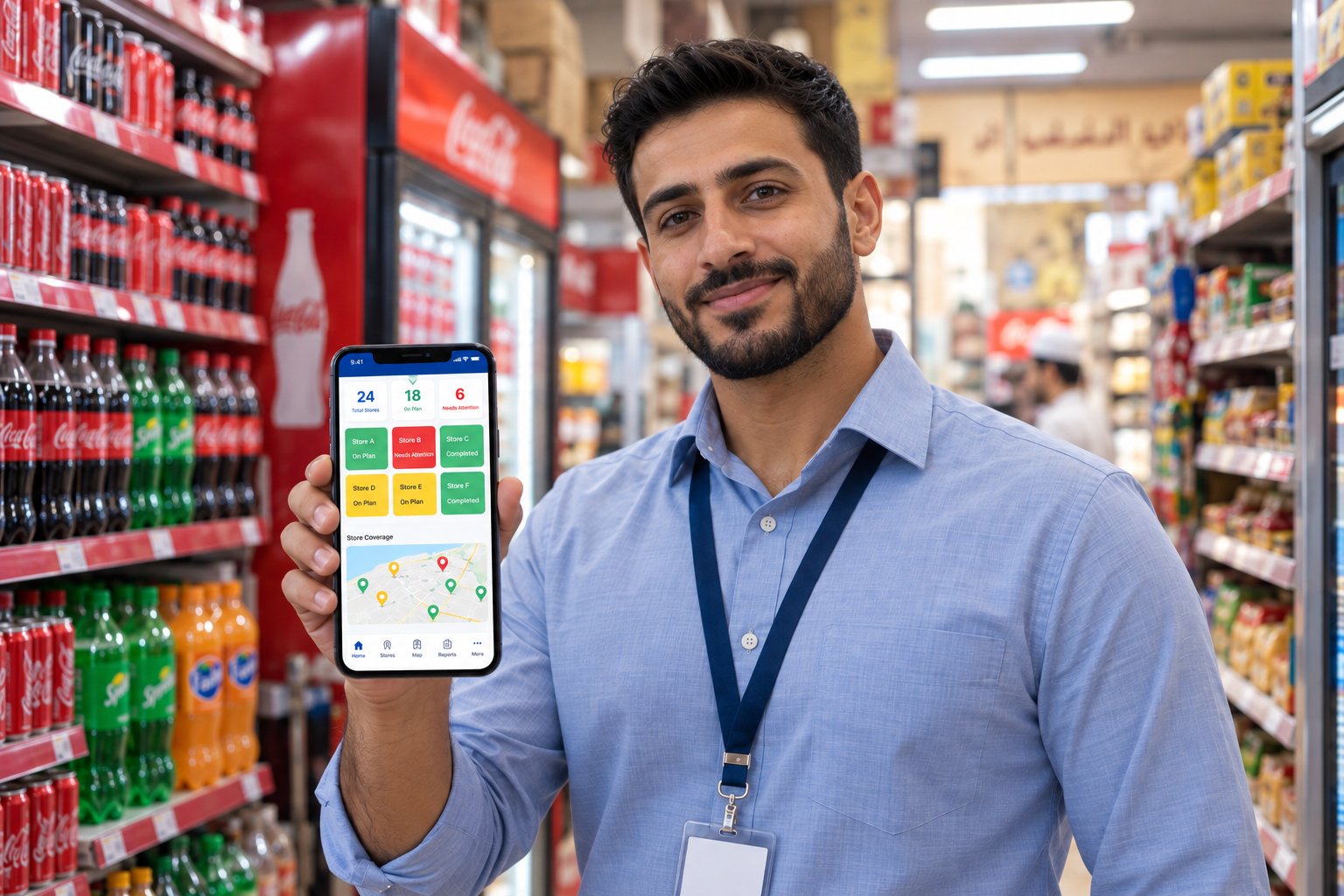
This is the performance dashboard layer that turns SFA from a data-entry system into an execution cockpit. Combined with AI Chat Report, it gives managers two complementary views: a glanceable heatmap for the morning, and a plain-English question-and-answer view for the deeper analysis later in the day.
Six Channel Sub-Teams, Four Cities, One System
A Gulf bottler does not have one sales force. It has at least six sub-teams, and each one runs a different rhythm.
- Abu Dhabi GT — General Trade across the capital and surrounding areas, long-tail outlets, relationship-driven.
- Al Ain GT — the garden-city region, smaller outlet base, longer drive times between visits.
- Sharjah GT — the dense, fast-moving northern emirate, high visit frequency.
- Dubai GT — General Trade in the most competitive market, where share is won or lost every day.
- Dubai MT — Modern Trade across the key accounts and supermarket chains, where a single order can move a category.
- HORECA — hotels, restaurants, and cafés, with fewer accounts and larger orders on a different cadence.
Most SFA rollouts run these sub-teams on the same database but with different friction profiles. The Dubai MT supervisor wants one report, the Al Ain GT supervisor wants another, and the HORECA rep is still working the old way because the app is built for the MT workflow.
The UAE team decided to run all six on one SFA, with channel-specific views and a shared data backbone. The result is that a single store visit — whether it is a corner shop in Al Ain, a hotel bar on Sheikh Zayed Road, or a Lulu hypermarket in Sharjah — feeds the same order, the same execution data, and the same SKU master. The supervisor no longer reconciles three views. The data is one view, viewed six ways.
In practice, this is what a unified route-to-market feels like on the ground. It is not a feature flag. It is the difference between six sub-teams reporting to the same planning meeting and six sub-teams arguing about whose number is right.
Four Gulf Markets, One Rollout
The UAE launch is the first of four. Oman, Qatar, and Bahrain are sequenced next, on the same platform, with the same SFA, and with the same friction-removal playbook.
That matters because most multi-market rollouts in CPG break at the second market. The first market gets custom attention, the second market inherits whatever the first market built, and the third market finds itself in a half-finished state. The UAE team built the playbook first, then applied it. Oman, Qatar, and Bahrain do not get a custom launch — they get a tested playbook.
The result is that the second, third, and fourth market will likely move faster than the first, because the friction is already known and the answers are already in the app. That is the actual compounding benefit of getting day one right.
The Lesson for Other CPG Teams
Field reps do not resist technology. They resist friction. Most SFA rollouts in CPG fail not because the ambition is wrong, but because the rollout adds friction before it removes any. Gartner frames the agentic-AI shift in sales execution as moving from assistive prompts to action-taking assistants — but assistants only earn adoption when the workflow underneath is already lean.
The Coca-Cola UAE SFA rollout reversed the order. Three frictions were removed before launch — search, recommendation, and supervision — and the activation followed. The app did not have to “win” the field. It just had to not get in the way.
For other CPG teams planning their own SFA upgrade, the pattern is the same:
- Build readiness before you build features. The five-pattern readiness program (walkthrough, market visit, outlet visit, demo, Q&A) is what produced the 100% number. The features alone would not.
- Audit the frictions your reps hit today. Not the frictions in the demo, the ones in the real visit. Search, recommendation, supervision — the three patterns this article covers.
- Remove the top three before launch. Each removal is a small build, but together they change the activation curve.
- Run multiple sub-teams on the same data backbone. GT, MT, HORECA, and any other channel — one platform, channel-specific views.
- Sequence markets on a tested playbook. The first market writes the playbook, the next three run it.
That is the sequence. The activation follows.
A Note From the Field
The UAE team that made this launch happen did the unglamorous work. They mapped the SKUs. They re-coded the channels. They sat with reps in Abu Dhabi, Al Ain, Sharjah, and Dubai and watched them try to break the new flow. They re-coded again. They tested in two stores, then twenty, then two hundred. They ran five patterns of readiness across six sub-teams, in four cities, in two weeks. By the time the app went live across the country, the friction was already gone.
Hats off to the UAE sales team. The next three markets are in good hands.
FAQ
What was the activation result of the Coca-Cola UAE SFA launch?
The new SFA reached 100% user activation across the UAE field force on day one, covering six channel sub-teams (Abu Dhabi GT, Al Ain GT, Sharjah GT, Dubai GT, Dubai MT, and HORECA) in four cities (Abu Dhabi, Al Ain, Sharjah, and Dubai).
Which frictions were removed before the launch?
Three: voice and barcode product search replaced tab-based menus, must-have SKUs were surfaced inside the call screen, and color-coded performance dashboards replaced slow report grids for supervisors.
How was readiness built before the launch?
The UAE team ran a five-pattern readiness program in the two weeks before go-live: walkthrough sessions for every sub-team, market visits in real outlets, outlet visits for HORECA and MT accounts, live demonstrations on the actual SFA, and structured Q&A and feedback that fed back into the build the same day.
How many markets are included in the rollout?
Four Gulf markets. UAE is live, with Oman, Qatar, and Bahrain sequenced next on the same platform and the same friction-removal playbook.
Does this replace the field rep?
No. The system removes search, recommendation, and supervision friction so the rep can stay in the conversation with the buyer. The rep is still the one who walks in, makes the case, and closes the order.
What broader eBest capabilities sit behind the launch?
The UAE launch uses SFA fundamentals (barcode + voice search, color-coded dashboards, must-have SKU visibility) and is set up to extend into AI sell-in suggestion, AI Chat Report, and AI Selling Story as the rollout expands.
*See how the full route-to-market platform turns a one-market launch into a four-market playbook — and what other CPG teams can borrow from the day-one activation curve.*
Ready to Transform Your Sales Force?
Discover how AI-powered SFA software can help your CPG company boost field productivity, improve retail execution, and drive revenue growth.