

Agentic AI for CPG: What Field Teams Actually Get

Most route-to-market teams already feel the gap. The data exists — in the SFA, the DMS, the ERP, a dozen spreadsheets — but it never quite reaches the rep standing in front of the store manager. That lag is where deals slip, shelves go unbuilt, and promotions get claimed but never verified.
Agentic AI for CPG is the shift that closes that lag. Not a chatbot that answers questions, but a layer of autonomous agents that actually does the route-to-market work: plans the day, reads the shelf, writes the order, files the report. This post is the overview — the map that connects the pieces and, more importantly, the argument for why eBest’s approach gives you an advantage a generic AI platform cannot.
What agentic AI for CPG really means
“Agentic” gets used loosely, so let’s be specific. In a CPG route-to-market context, it means a system that can chain several steps toward a business goal without a human scripting each one. A sell-in agent doesn’t just list products — it pulls the store’s history, reads the season, weighs the live promotion, and hands the rep a ranked, explained shortlist, then learns from what actually sold.
That is a different bet from dropping a large language model into your stack and hoping teams figure it out. The model is not the product. The agents, the skills, the CPG knowledge, and the guardrails wired around them are. External: IBM — What is agentic AI
One platform, sixteen agents, five phases of the working day
eBest’s Agentic AI platform ships with 16 business agents organized around the rep’s real day:
- Before leaving the office — smart route planning, store insight, sell-in suggestion, and a generated selling story.
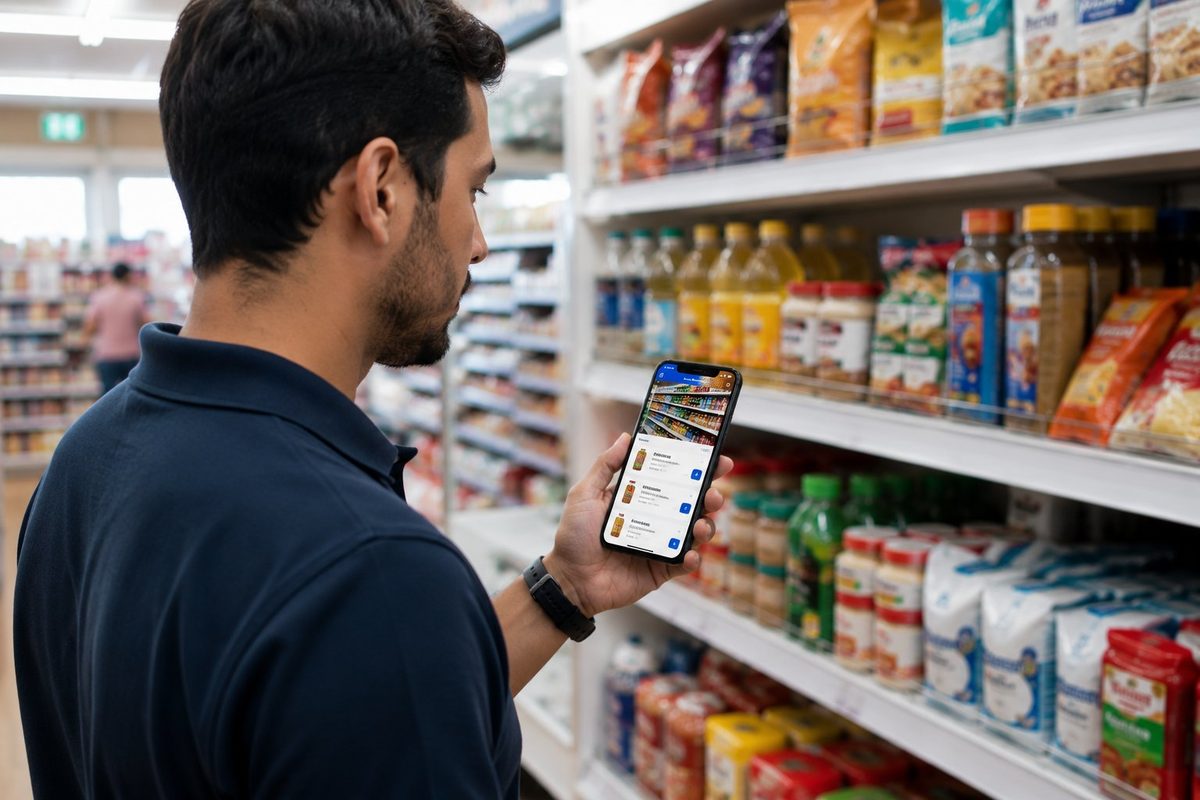
- In the store — perfect-store visual check, menu and receipt recognition, voice ordering, suggested order.
- After leaving — next-best-action, daily summary, conversational reporting, personal KPI coaching.
- For managers — team KPI diagnosis and adaptive training.
Each agent is a packaged scenario you switch on individually. Pilot two or three, prove the value, then expand. Underneath, a five-layer architecture — entry, application, capability, model, compute — keeps business data on the tenant side while the platform manages configuration, metadata health, and audit trails. The same SFA/RTM foundation the agents run on means they read and write real business objects directly. Internal: eBest SFA
Here is what a day looks like with the agents live: the rep opens the app and sees a re-sequenced route based on store weight, distance, and yesterday’s misses; before the first visit, a one-screen brief names the top three SKUs to push and the story to tell; in the aisle, a shelf photo returns a compliance score in seconds; the order is spoken, not typed; and at 6 p.m. the daily summary is already written — the rep just confirms it.
Why eBest’s agentic AI for CPG beats generic platforms
This is where the advantage shows. Large generic AI platforms sell you the ability to *build* agents. eBest sells you agents that are already *built* for consumer-goods route-to-market.
| Dimension | Generic AI agent platform | eBest Agentic AI for CPG |
|---|---|---|
| Positioning | Tools to build agents, models, cloud | Out-of-the-box CPG RTM agent scenarios |
| Time to value | Build platform → integrate → build scenes | 16 preset scenarios, pilot in weeks |
| Industry know-how | Generic; you build models & knowledge | Prebuilt store, shelf, order, visit, KPI models |
| System linkage | Heavy custom SFA/DMS integration | Native on the same SFA/RTM base |
| Model strategy | Tied to one vendor’s ecosystem | Neutral: default model, switch to yours or private |
| Deployment & data | Mostly public cloud | SaaS / private cloud / on-prem, data boundary on your side |
Five differences matter most:
Built for CPG, not generic. The 16 scenarios are pre-trained on store, shelf, order, visit, and KPI models and knowledge. A generic platform hands you raw tools; you still assemble the industry.
Model-neutral by design. The platform ships with a default foundation model for fast startup, but you can run your own model or a private one. No lock-in to a single vendor’s ecosystem.
Your data stays on your side. On private cloud or on-prem, business data never leaves your environment. The platform only sees configuration and metadata health — a clean boundary for compliance and security teams.
Native to the systems reps already use. Because the agents run on the same SFA/RTM foundation, they read and write real business objects directly. No months of custom integration plumbing. Internal: eBest DMS
A platform for continuous operations. The whole point is to carry ongoing operations. New agents and skills snap onto the same base. You stop building and start compounding.
That last point is the thesis: agentic AI for CPG moves the center of gravity from *building the platform* to *cashing in the business value*.
From platform build to business value
The numbers that matter are hours given back to selling. The daily-summary agent is designed to collapse report-writing from roughly 30 minutes to a one-minute confirmation. The coaching agent turns role-play and personalized feedback into a pathway that can pull a new rep’s ramp from three months toward one. Voice ordering turns a multi-minute order entry into a few spoken sentences. Internal: AI voice ordering
None of that requires a data-science team on staff. It requires a platform that already speaks CPG.
How it deploys: SaaS, private cloud, on-prem
You choose the boundary that fits the risk profile:
- SaaS on eBest’s managed cloud — fastest pilot, smallest team.
- Private cloud in your own account or VPC — data stays in your cloud, model can be yours.
- On-prem — data fully in your environment, for internal-network-only operations.
The base subscription plus modular agents means you pay for what you enable, and pilot setup fees are often waived. External: McKinsey — AI in consumer packaged goods
Start with one measurable pilot
The implementation path is deliberately small: pick a business domain and two or three high-frequency scenarios, confirm the role and acceptance metrics, configure and connect, run the pilot, then expand. Four to eight weeks is a normal pilot window.
You don’t need to boil the ocean. You need one scenario, one team, one number that moves. If you want the deeper cut on any single agent, we’ve written standalone pieces on AI sell-in suggestion, perfect-store image recognition, and AI voice ordering.
FAQ
Is agentic AI for CPG the same as generative AI?
No. Generative AI produces text or content. Agentic AI orchestrates multiple steps — often using generative models — to complete a business task end to end.
Do we have to use a specific model?
No. A default model is provided for fast startup; you can run your own model or a private one. The gateway is model-neutral.
Will our store and order data leave our environment?
Only if you choose SaaS. On private cloud and on-prem, business data stays within your boundary; the platform manages configuration and audit, not your records.
How is this different from adding an AI assistant to our SFA?
An assistant answers. eBest’s agents act — they plan routes, check shelves, write orders, and file reports inside the systems you already run.
How long until we see value?
Most pilots target 4–8 weeks, starting from two or three scenarios with defined acceptance metrics.
The bottom line
If you’re evaluating agentic AI for CPG, the question isn’t “which model.” It’s “whose agents already know route-to-market.” eBest’s 16-agent platform is the out-of-the-box answer — CPG-ready, model-neutral, data-sovereign, and built to keep delivering after the pilot ends.
*Talk to us about a scoped pilot on your highest-frequency scenario. We’ll map the agents, the data, and the one metric worth moving first.*
Ready to Digitize Your Route to Market?
Learn how eBest’s integrated SFA, DMS, and TPM platform helps leading CPG brands turn distribution data into competitive advantage.