
AI Route Optimization for CPG Field Sales: 2026 Guide
Quick Answer
AI route optimization for CPG field sales uses machine learning to plan the most efficient multi-stop store visit sequences — factoring in store priority, service time per outlet, merchandising task requirements, traffic conditions, and trade promotion windows. Unlike generic logistics routers, CPG-specific AI route optimization learns from each representative’s actual field performance, continuously improving route economics. Companies using AI route optimization typically achieve 20-30% more store visits per day while reducing total drive time by approximately 22%.
Introduction
Every morning, thousands of CPG field sales representatives across emerging markets face the same question: which stores should I visit today, and in what order? For decades, the answer came from sales managers drawing lines on paper maps or using static territory plans that ignored real-world variables like traffic congestion, store opening hours, and merchandising task duration. The result is a staggering amount of wasted time — NielsenIQ research on CPG route economics confirms that field representatives spend 25-35% of their working hours simply traveling between outlets rather than selling at the shelf.
The shift toward AI route optimization is changing this equation fundamentally. By applying machine learning algorithms to route planning, CPG companies can now dynamically optimize daily visit sequences across thousands of outlets, factoring in dozens of variables that human planners simply cannot process. In this comprehensive guide, we explore how AI route optimization works specifically for CPG field sales, why generic logistics routers fall short, what measurable benefits sales directors can expect, and how global enterprises like Nestlé are already achieving double-digit productivity gains through intelligent routing.
Why CPG Companies Need AI Route Optimization
The economics of CPG field sales hinge on one deceptively simple metric: how many productive store visits can each representative complete per day. Yet the variables that determine this number — traffic patterns, store service times, merchandising task complexity, trade promotion execution windows, and inventory replenishment urgency — interact in ways that make manual route planning fundamentally suboptimal.
The Hidden Cost of Manual Route Planning
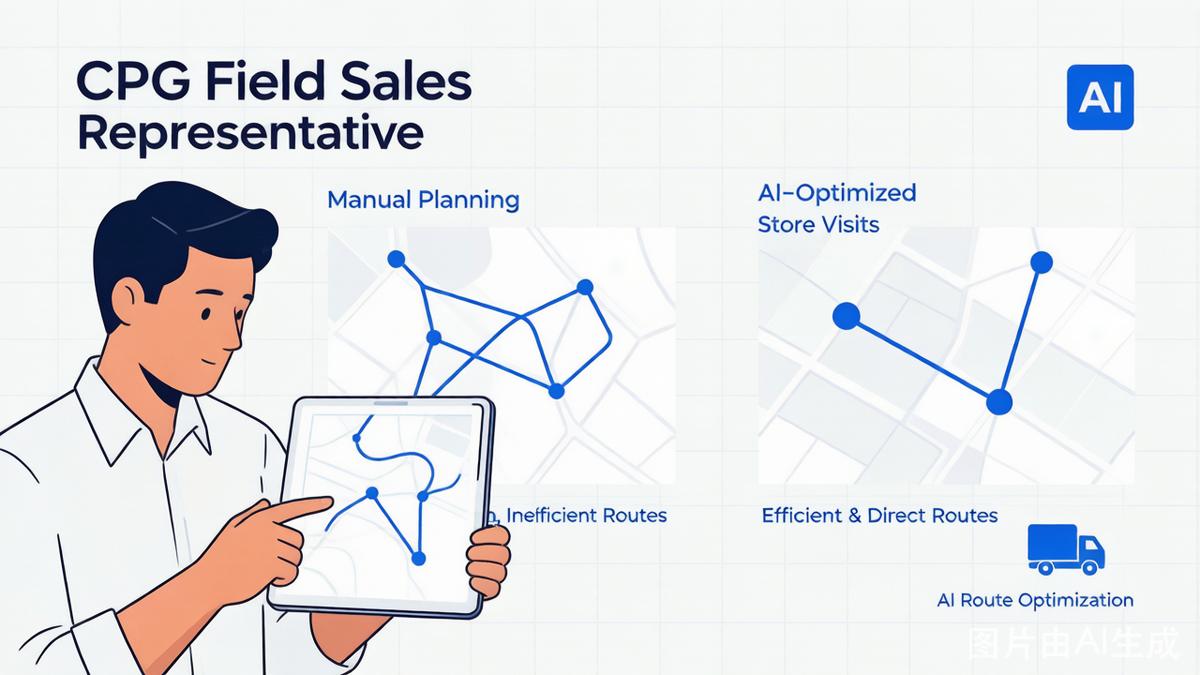
Traditional territory planning treats routing as a geography problem. Sales managers divide regions into zones, assign representatives to fixed sets of outlets, and expect them to figure out the optimal daily sequence themselves. In practice, representatives default to habit — visiting stores in the same order week after week regardless of whether that sequence actually minimizes travel time or maximizes in-store impact.
The financial consequences compound quickly. Consider a CPG company with 500 field representatives, each spending an average of 2.5 hours per day driving between outlets. If AI route optimization reduces drive time by just 20%, that translates to 250 hours of recovered selling time per day across the field force — equivalent to adding 31 full-time representatives without hiring a single person. Over the course of a year, this productivity gain delivers millions in incremental revenue at the shelf.
Furthermore, manual routing fails to account for store-level variability. A key account supermarket might require 45 minutes for a full merchandising audit and order placement, while a small neighborhood store needs only 10 minutes for a quick shelf check. When representatives plan their own routes without AI assistance, they inevitably cluster too many high-service-time stores together, creating unsustainable daily schedules and rushed visits that undermine in-store execution quality.
How AI Route Optimization Transforms Field Team Productivity
AI route optimization goes beyond simply finding the shortest path between points. A true CPG-calibrated AI routing engine simultaneously optimizes for multiple objectives: minimizing total drive time, maximizing the number of high-priority store visits, ensuring adequate time allocation for merchandising tasks at each outlet, adjusting for time-sensitive trade promotion execution windows, and accommodating real-time disruptions such as store closures or sudden order spikes.
The machine learning layer is what distinguishes AI route optimization from basic route planners. The system learns from historical data — which routes actually performed well last week, which stores consistently take longer than expected to service, which roads are reliably congested at specific times — and continuously refines its optimization model. Over weeks and months, this learning loop produces routes that reflect the messy realities of CPG field operations rather than idealized travel-time assumptions.
Moreover, AI route optimization creates organizational transparency. Regional sales directors gain real-time visibility into route adherence, actual vs. planned visit times, and the downstream impact of routing decisions on in-store execution scores. This data-driven approach replaces anecdotal territory management with measurable route economics, enabling leadership to make informed decisions about headcount allocation, territory redesign, and investment in route-to-market infrastructure.
Key Features to Look for in AI Route Optimization Software
Not all AI route optimization tools are built for the demands of CPG field sales. Gartner’s Market Guide for Sales Force Automation notes that many solutions on the market excel at last-mile delivery routing — designing efficient sequences for trucks dropping off parcels — but lack the multi-stop, multi-task complexity that characterizes CPG field operations. When evaluating AI route optimization platforms, sales and IT leaders should prioritize features that directly address the unique requirements of retail store visits with variable service times, merchandising tasks, and trade promotion execution needs.
Multi-Stop, Multi-Task Route Intelligence
CPG field representatives do not simply visit stores — they execute a layered set of activities at each outlet. A single store visit might include checking shelf stock levels, placing an order, setting up a promotional display, conducting a planogram compliance audit, capturing shelf-share photos, and discussing category performance with the store manager. Each of these tasks carries a different time requirement, and the total service time per store can range from 10 minutes to over an hour.
Consequently, effective AI route optimization must treat each store visit as a multi-task entity rather than a single point on a map. The routing algorithm needs to estimate service duration based on the tasks scheduled for each outlet and ensure that daily route plans are realistic — factoring in not just drive time but total time from depot to final visit. Platforms that only optimize for distance traveled will consistently produce routes that are mathematically efficient but operationally impossible to complete within a working day.
Real-Time Re-routing and Adaptive Scheduling
Field conditions change constantly. A key account manager calls in sick, a major retail chain requests an emergency promotional audit, unexpected road construction turns a normally fast route into a 45-minute detour. Static route plans — even AI-generated ones — become obsolete the moment a representative steps out the door if they cannot adapt to real-time disruptions.
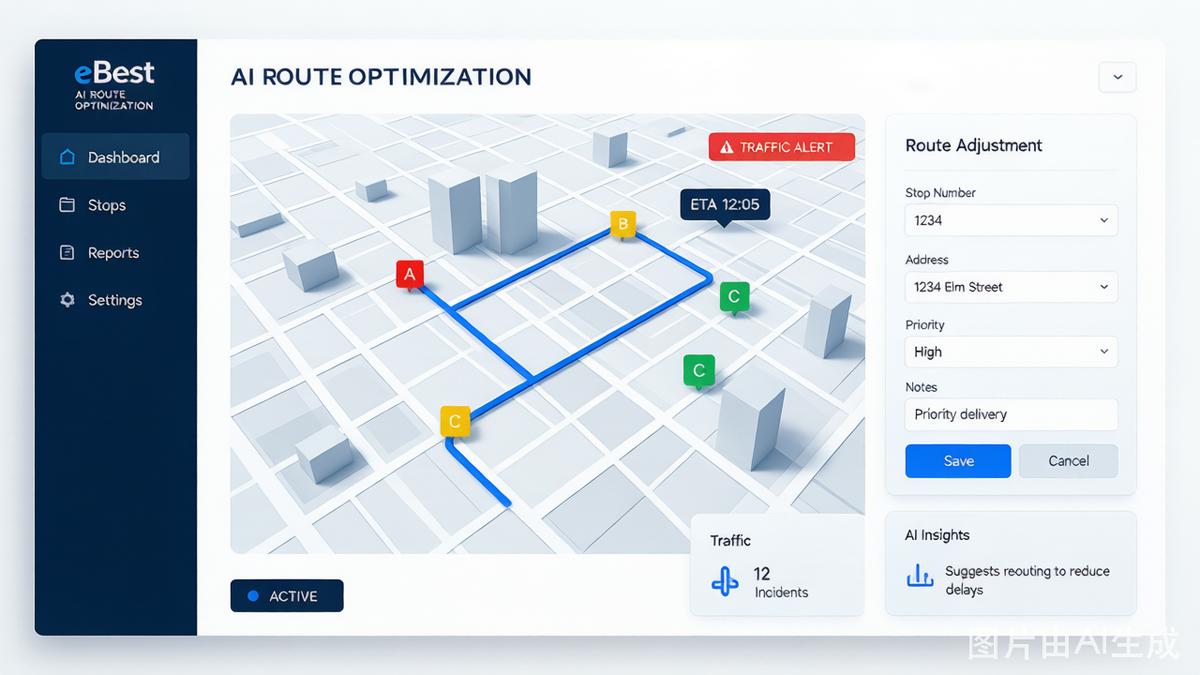
The best AI route optimization platforms include real-time re-routing capabilities that dynamically adjust visit sequences as conditions change. When a store cancels a scheduled visit or an urgent task emerges at a high-priority outlet, the system recalculates optimal routes in seconds and pushes updated plans to the representative’s mobile device. This adaptive capability ensures that field teams stay productive regardless of disruptions, rather than defaulting to ad-hoc decision-making that sacrifices route efficiency.
Integrated Platform: SFA + AI Route Optimization + DMS
Route optimization does not operate in isolation. For field sales operations, routing decisions directly impact — and are impacted by — sales force automation (SFA) task assignments, distributor management system (DMS) inventory levels, and trade promotion management (TPM) execution calendars. A standalone route planner that does not integrate with these systems creates duplicate data entry, inconsistent task visibility, and fragmented reporting.
Therefore, CPG companies should prioritize AI route optimization solutions that operate as part of a unified route-to-market platform. When routing is natively integrated with SFA, representatives receive their optimized route alongside their daily tasks, order forms, and merchandising checklists in a single mobile application. When integrated with DMS, routing decisions can factor in distributor stock levels to prioritize outlets that urgently need replenishment. When connected to TPM, routes automatically account for promotion activation dates and compliance audit windows. This unified approach eliminates the friction of switching between applications and ensures that route optimization delivers its full productivity potential.
How eBest Delivers AI Route Optimization for CPG Enterprises
eBest has built AI route optimization directly into its unified CPG sales platform, making intelligent routing a native capability rather than a third-party bolt-on. Unlike generic route planners, eBest’s AI engine is calibrated specifically for the multi-stop, multi-task, multi-priority reality of CPG field sales — it factors in store service time variability, merchandising task requirements, perfect store audit windows, and trade promotion timing to produce routes that are both efficient and operationally executable.
The Nestlé deployment in emerging markets illustrates the impact. Managing a field force responsible for servicing over 200,000 retail outlets, Nestlé needed AI route optimization that could adapt to complex variables: unpredictable traffic conditions across multiple cities, widely varying store formats requiring different service times, and the need to coordinate merchandiser capacity with sales representative schedules. eBest’s AI route optimization engine learned from each representative’s actual field performance, continuously refining routes to account for real-world conditions rather than idealized travel-time models.
The results were substantial: average route time decreased by 22%, while store visit frequency increased by 18%. Critically, these gains came without adding headcount — the same field force was simply covering more outlets more effectively, directly driving incremental sell-through at the shelf. As McKinsey’s research on AI and the future of CPG route to market confirms, the shift from static to intelligent routing is one of the highest-impact applications of AI in consumer goods — and companies that move early are establishing durable competitive advantages in shelf availability and field force productivity.
Other global CPG customers — including Coca-Cola, Unilever, and Carlsberg — rely on eBest’s integrated platform, which combines SFA software for CPG field teams with AI route optimization, DSD software for CPG distributors, and trade promotion management in a single unified environment. For sales directors who want to see how route intelligence transforms field productivity, eBest’s CPG customer success stories provide additional real-world evidence. Readers interested in related capabilities can also explore our guides on retail execution software for CPG and sales force automation software for CPG, and browse more CPG route-to-market resources for deeper insights.
Frequently Asked Questions
Q1: What is AI route optimization for CPG field sales?
A: AI route optimization for CPG field sales is the application of machine learning algorithms to plan and continuously improve daily store visit sequences for field representatives. Unlike generic logistics routing, CPG-calibrated AI route optimization simultaneously accounts for store priority levels, variable service times per outlet, merchandising task requirements, trade promotion execution windows, traffic conditions, and representative capacity constraints. The system learns from historical performance data — which routes actually delivered the best results, which stores consistently require more service time, which roads are reliably congested at specific hours — and uses this learning to produce routes that maximize productive shelf time while minimizing non-productive travel. For CPG companies operating with hundreds of field representatives across thousands of outlets, this intelligent approach to routing consistently delivers 20-30% more store visits per day without increasing headcount.
Q2: How much can AI route optimization reduce operational costs for CPG companies?
A: Industry benchmarks and eBest customer deployments indicate that AI route optimization typically reduces total drive time by 20-25% while increasing daily store visit frequency by 15-30%. For a mid-size CPG company with 200 field representatives, a 22% reduction in drive time translates to approximately 110 hours of recovered selling time per day — equivalent to adding 14 full-time representatives at zero additional cost. Beyond direct fuel savings, the operational benefits include reduced vehicle maintenance costs, lower representative turnover due to improved work-life balance, and higher in-store task completion rates that drive measurable improvements in shelf availability and promotional compliance. CPG sales directors who deploy AI route optimization typically see full ROI within 3-6 months based on productivity gains alone, before accounting for the incremental revenue impact of more frequent and higher-quality store visits.
Q3: Does AI route optimization integrate with existing SFA and DMS platforms?
A: The most effective AI route optimization implementations are those natively integrated with a company’s existing sales force automation (SFA) and distributor management system (DMS) platforms. When routing intelligence is connected to SFA, representatives receive their optimized daily route alongside their task list, order forms, and merchandising checklists within a single mobile application — eliminating the need to switch between tools. Integration with DMS enables the routing engine to factor in distributor inventory levels, prioritizing outlets with urgent replenishment needs. Standalone route planners that operate in isolation create data silos, require duplicate data entry, and fail to capture the full operational context that drives optimal routing decisions. When evaluating AI route optimization solutions, CPG companies should prioritize platforms that offer unified route-to-market capabilities — SFA, DMS, TPM, and routing — rather than attempting to stitch together disconnected point solutions. Integration quality is the single biggest determinant of whether AI route optimization delivers its theoretical productivity gains in practice.
Q4: Is AI route optimization suitable for both urban and rural CPG distribution?
A: AI route optimization delivers value across both dense urban territories and dispersed rural distribution networks, though the optimization logic differs between the two. In urban environments, the primary challenge is managing multi-stop complexity — a representative might visit 30-40 outlets in a single day, and the routing algorithm must balance travel time against service time across dozens of short-distance stops while accounting for variable traffic conditions, parking availability, and store opening hours. In rural territories, the challenge shifts to minimizing long-distance travel between widely scattered outlets while ensuring that each visit justifies the travel investment. AI route optimization handles both scenarios by learning territory-specific patterns: in urban areas, it optimizes for stop density and visit sequencing; in rural areas, it optimizes for cluster-based routing that groups geographically compatible outlets into efficient daily loops. Companies with mixed urban-rural territories — which describes virtually all CPG enterprises operating in emerging markets — benefit from a routing engine that adapts its optimization strategy to each territory type rather than applying a one-size-fits-all algorithm.
Q5: How do I choose the right AI route optimization tool for my CPG business?
A: Selecting the right AI route optimization platform requires evaluating five critical dimensions. First, CPG specificity: does the tool account for variable store service times, merchandising tasks, and perfect store audit requirements, or is it a generic logistics router repurposed for field sales? Second, integration depth: does it connect natively with your SFA, DMS, and TPM platforms, or will your team need to maintain separate systems? Third, learning capability: does the AI engine improve over time by learning from actual route performance data, or is it a static algorithm that never adapts? Fourth, offline resilience: can representatives receive updated routes and record visit data in areas with unreliable connectivity? Fifth, enterprise scalability: can the platform handle thousands of representatives and tens of thousands of outlets without performance degradation? We recommend running a structured pilot in one sales region for 4-6 weeks, measuring baseline metrics before deployment and tracking the same KPIs during the pilot period. The most telling indicators are not vendor claims but your own before-and-after data on visits per rep per day, drive time per visit, and in-store task completion rates.
Conclusion
AI route optimization represents one of the highest-ROI technology investments available to CPG field sales organizations today. The math is straightforward: when 500 representatives save 30 minutes of drive time each day through AI route optimization, the company gains 250 hours of additional selling time — every single day — without adding headcount or increasing costs. As Nestlé’s emerging markets experience confirms, the productivity gains are real, measurable, and sustainable.
Route optimization is also the natural on-ramp to the broader shift to AI for CPG sales — where co-selling assistants plan the visit, generate the pitch, and verify the shelf, not just the route.
- AI route optimization delivers 20-30% more store visits per day by replacing manual route planning with machine learning that continuously improves based on real field performance data.
- CPG-specific routing engines outperform generic logistics tools because they account for variable store service times, merchandising tasks, trade promotion windows, and perfect store audit requirements.
- Integrated platforms that combine AI route optimization with SFA, DMS, and TPM eliminate data silos and ensure routing intelligence produces routes that are both efficient and operationally executable.
Ready to transform your CPG route to market with AI-powered field intelligence? Explore eBest SFA with built-in AI route optimization or contact our team to schedule a demo with your territory data.
Ready to Digitize Your Route to Market?
Learn how eBest’s integrated SFA, DMS, and TPM platform helps leading CPG brands turn distribution data into competitive advantage.