
SFA Software for CPG Companies: How to Choose and Deploy
SFA software for CPG companies is a mobile-first field-sales platform built for route-to-market, not account management. Where a generic CRM tracks deals, CPG SFA software directs store coverage, captures perfect-store execution in the field, and routes reps through thousands of outlets a week. The strongest deployments add AI sell-in suggestion, AI route optimization, and perfect store image recognition so a rep walks into each visit knowing exactly what to pitch and where to go next.
Why CPG Companies Need SFA Software for CPG Companies
Most consumer-goods brands lose more sales to broken execution than to weak strategy. A planogram gets agreed at headquarters, yet the shelf in a tier-3 city tells a different story. That gap is the whole reason SFA software for CPG companies exists. It turns the field force from a group of visitors into a measured, coachable system.
Consider the weekly reality of a beverage or snacks brand. A single key-account manager may own 40 hypermarkets; a van-sales driver may cover 60 traditional trade outlets a day. They don’t need a CRM that logs a “lead.” They need a tool that tells them which stores to visit, what to check when they arrive, and what to sell based on what that specific store actually buys. Off-the-shelf sales tools miss this, because they were designed for B2B deal cycles, not for repetitive, high-frequency store coverage.
That is the core argument for purpose-built SFA software for CPG companies: it treats outlet coverage as the primary unit of work. Visits are scheduled by route and priority, not by whoever picked up the phone. Execution data — share of shelf, POSM presence, stock status — is captured at the shelf, not reconstructed later in a spreadsheet. And because the data lands in near real time, a regional manager can spot a failing outlet before the month closes, not after.
The payoff is operational, not cosmetic. When execution is visible, coaching becomes specific. A rep who skips the frozen-aisle secondary display shows up in the data; a territory with slipping perfect-store scores gets attention while it is still fixable. NielsenIQ’s retail-execution research consistently ties on-shelf availability to lost sales at the moment of purchase, which is exactly the failure CPG SFA software is built to prevent (NielsenIQ insights).
What Makes SFA Software for CPG Companies Different from a CRM?
This is the question that quietly decides most buying mistakes. A CRM answers “who are my prospects and where is the deal?” CPG SFA answers “which stores did we cover, what did we find, and what did we sell?” The objects are different: outlet instead of account, visit instead of opportunity, execution instead of pipeline.
Because the unit of work is the store visit, the data model has to support things a CRM never touches — van stock, secondary placements, planogram compliance, and distributor reconciliation. If your tool can’t model a traditional-trade outlet that has no fixed buyer and no email address, it isn’t SFA software for CPG companies. It’s a contact manager wearing a field-sales costume.
How Does SFA Software for CPG Companies Differ from a Generic CRM?
The difference shows up the first time your team works in a store with patchy signal. Generic platforms assume a connected laptop and a calm Wi-Fi session. CPG field work assumes a crowded aisle, a dead zone, and a rep who has thirty seconds before the store owner loses patience. That single assumption — connectivity — splits the two product categories apart.
Take architecture first. True SFA software for CPG companies is offline-first, not merely offline-capable. The rep opens the app on a metro train, reviews the day’s route, captures a shelf photo, and syncs the moment a signal returns. A generic CRM that “works offline” usually means a cached view that breaks the moment the rep tries something the cache didn’t anticipate. In emerging markets — India, Indonesia, Kenya, the Middle East — that gap is the difference between adoption and quiet abandonment.
Then there’s the route-to-market lens. CPG selling is repetition at scale: the same 200 outlets, visited on a rhythm, with execution checked every time. A generic CRM optimizes for the rare, high-value negotiation. CPG SFA optimizes for the daily grind of coverage, so the system pushes the next best store, not the next big deal. Gartner’s sales-technology coverage repeatedly frames field-sales execution as a distinct discipline from pipeline CRM, which is why the two are evaluated on different criteria (Gartner sales technology).
Offline-First Architecture for Emerging Markets
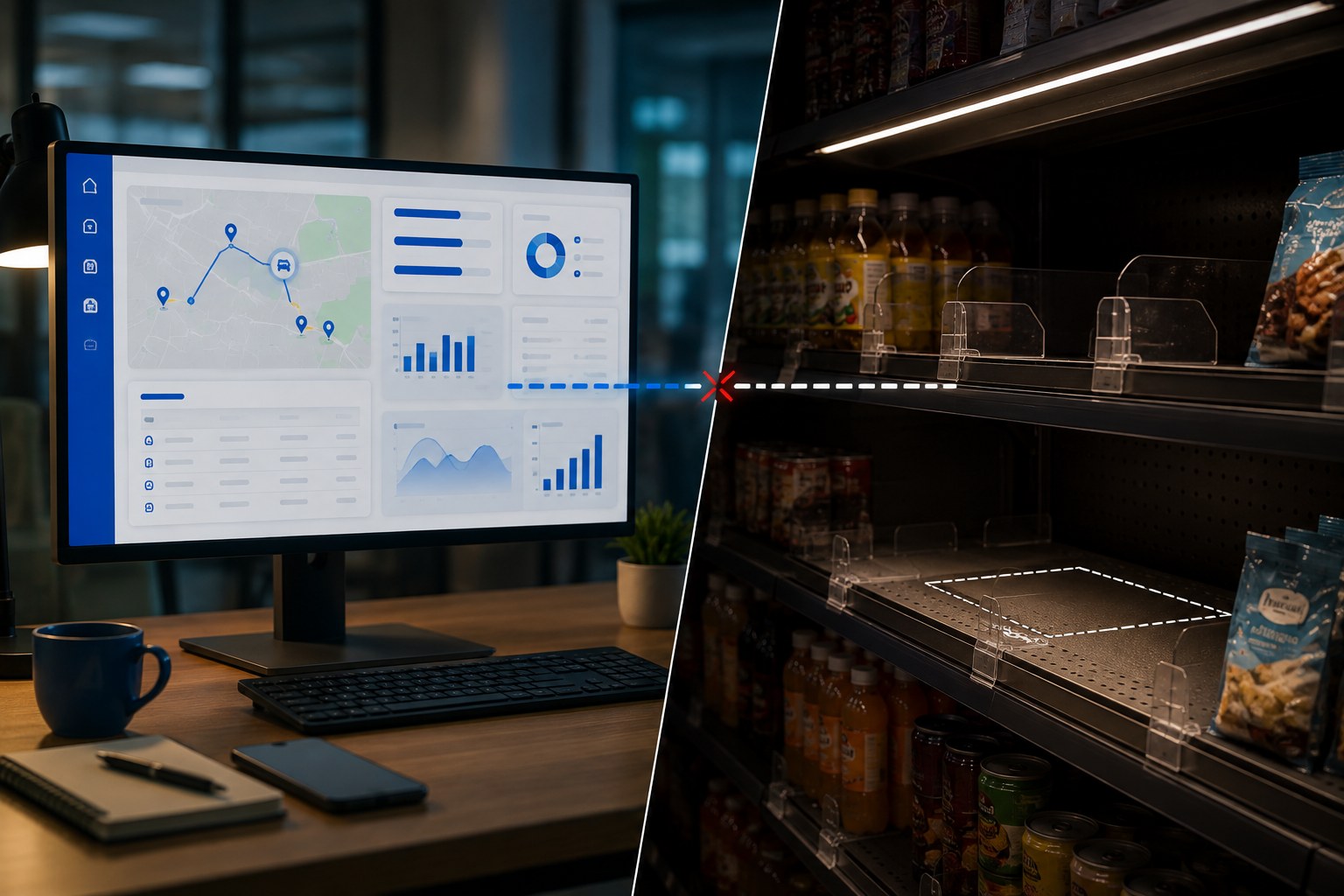
Connectivity is not a nice-to-have in CPG field work; it is the first thing that breaks. Offline-first means the rep’s full working set — outlet list, visit history, product catalog, and capture forms — lives on the device. Sync is background and conflict-aware, so two reps editing the same outlet don’t clobber each other. Brands running rural or peri-urban coverage cannot treat this as optional.
Route to Market, Not Account Management
The second differentiator is what the system optimizes. CPG SFA software sequences visits by coverage need, promotional calendar, and outlet priority. It asks “which stores are due, and in what order, to protect distribution?” A CRM asks “which opportunity is closest to closing?” Those are different questions with different daily behaviors. Choose the tool that asks the CPG question.
Perfect Store Execution Built In
Third, execution has to be captured where it happens. Photograph the shelf, and the system should score share of shelf and planogram compliance on the spot. This is perfect store image recognition — a named capability, not a vague “AI module.” When the rep sees the gap immediately, the correction happens during the visit, not in next month’s review.
What AI Capabilities Should SFA Software for CPG Companies Include?
AI is where most vendors now over-promise and under-deliver. The fix is to name the capability and the workflow it touches. For SFA software for CPG companies, four capabilities actually move execution, and each maps to a moment in the rep’s day.
First, AI sell-in suggestion works at the start of a visit. The system reads the store’s profile and local best-sellers, then recommends which products to pitch and generates a tailored selling talk-track. The rep sells smarter in the first ninety seconds, instead of guessing.
Second, AI route optimization sequences the day. It weighs outlet priority, distance, visit frequency, and live conditions to build a route that protects coverage without burning the rep’s hours on the road. McKinsey’s consumer-goods work on route-to-market points to exactly this kind of optimization as a lever for both cost and reach (McKinsey CPG insights).
Third, perfect store image recognition turns a shelf photo into structured execution data — facings, share of shelf, POSM presence, and special displays — with a human-in-the-loop appeal when the AI misses. Fourth, AI Chat Report lets a manager ask a plain-language question and get a store-execution answer back, no BI training required. Stack those four and the field force becomes measurably sharper without adding headcount.
How to Choose and Deploy SFA Software for CPG Companies
Choosing well is less about feature lists and more about matching the tool to your route-to-market reality. The framework below keeps the decision grounded, then turns it into a deployment sequence most brands can run in a single quarter.
Start by mapping the actual work. How many outlets, across which channels, served by which model — direct, distributor, or van? A tool that fits a 5,000-outlet direct force will choke a distributor-led market, and vice versa. Next, shortlist only vendors built for CPG field execution, and reject any demo that leans on B2B-CRM language. Then pilot offline-first in one region before you sign a scaling commitment. Finally, switch on the AI capabilities in order — sell-in suggestion and route optimization first, because reps feel them on day one, then perfect-store recognition and conversational reporting once the data is flowing.
The deployment itself follows five steps. Treat them as a sequence, not a menu.
- Map your route-to-market reality. List outlets, channels, and the selling model (direct, distributor, van) so the platform matches how you actually go to market.
- Shortlist CPG-native vendors. Remove any tool that frames the field force as “leads” — keep only those built for store coverage and execution.
- Run an offline-first pilot in one region. Prove the app works in dead zones before you bet the entire force on it.
- Turn on AI capabilities in order. Start with AI sell-in suggestion and AI route optimization, then add perfect store image recognition and AI Chat Report.
- Scale with distributor and promotion integration. Connect DMS and trade promotion management so execution and incentives stay in sync.
How eBest Solves This
eBest builds SFA software for CPG companies as part of one unified route-to-market stack — SFA, DMS, TPM, DSD, and B2B on a single platform, rather than bolted-on modules. That matters because execution problems rarely stay inside one system: a missed display is a promotion problem, a stockout is a distributor problem, and a weak pitch is a training problem.
The real proof is in live rollouts. Coca-Cola’s UAE SFA deployment went live across six sub-teams with full day-one adoption, a story documented in our Coca-Cola SFA rollout. Global brands such as Nestlé and Unilever run eBest across complex, distributor-heavy markets where offline-first coverage is non-negotiable. Under the hood, the same AI capabilities named above — AI sell-in suggestion, AI route optimization, and perfect store image recognition — sit inside the SFA layer, while a distributor management system and trade promotion management software keep the rest of the chain connected. The result is fewer silos and a field force that executes the plan the company actually wrote.
Frequently Asked Questions
Q1: What is the best SFA software for CPG companies?
The best SFA software for CPG companies is the one built around store coverage and execution, not deal pipelines. Look for offline-first mobile capture, route-to-market sequencing, perfect-store execution, and distributor integration out of the box. AI sell-in suggestion and AI route optimization are strong differentiators because reps feel them immediately. Avoid any platform that frames your outlets as “leads” — that signals a CRM wearing a field-sales costume. Validate with a real pilot in a low-connectivity region before you commit, since that is where most generic tools quietly fail.
Q2: How long does it take to deploy SFA software for CPG companies?
Most brands can run a focused deployment inside a single quarter. The sequence is straightforward: map your route-to-market, shortlist CPG-native vendors, pilot offline-first in one region, switch on AI capabilities in order, then scale with distributor and promotion integration. The pilot is the critical gate — prove the app works in dead zones first. A unified stack like eBest’s shortens the timeline because SFA, DMS, and TPM already share data models, so you are not integrating three separate systems by hand.
Q3: Which AI capabilities does eBest include in its CPG SFA software?
eBest’s SFA layer includes several named, workflow-specific AI capabilities rather than one vague “AI module.” AI sell-in suggestion recommends products to pitch and generates a tailored talk-track per store. AI route optimization sequences the day around coverage and priority. Perfect store image recognition turns a shelf photo into structured share-of-shelf and planogram data, with a human appeal when the AI misses. AI Chat Report lets managers ask plain-language questions and get store-execution answers back. Each capability maps to a real moment in the rep’s day.
Q4: Is SFA software for CPG companies useful for small or traditional-trade markets?
Yes, and often it matters more there than in modern trade. Traditional-trade outlets — small groceries, baqalas, kiosks — have no fixed buyer and no email, so execution visibility depends entirely on what the rep captures at the shelf. Offline-first architecture is essential, because connectivity is unreliable. AI route optimization helps a van-sales driver cover more outlets per day, and perfect store image recognition flags missing displays without a supervisor physically visiting. The brands that win traditional trade are usually the ones that made field execution measurable first.
Q5: How is SFA software for CPG companies different from a generic CRM?
The core difference is the unit of work. A CRM optimizes for the deal: who is the prospect, where is the opportunity, when will it close. SFA software for CPG companies optimizes for the store visit: which outlets are due, what to check on arrival, and what to sell based on that store’s history. The data model reflects this — outlets, visits, van stock, and planogram compliance instead of accounts, pipelines, and leads. If your tool cannot model an outlet with no email address, it is a CRM, not CPG SFA.
Ready to see what purpose-built SFA software for CPG companies looks like in the field? Explore the eBest SFA platform or talk to our route-to-market team about a pilot in your toughest region.
Ready to Transform Your Sales Force?
Discover how AI-powered SFA software can help your CPG company boost field productivity, improve retail execution, and drive revenue growth.