
Will AI Replace Field Sales Reps? The Data-Backed Answer
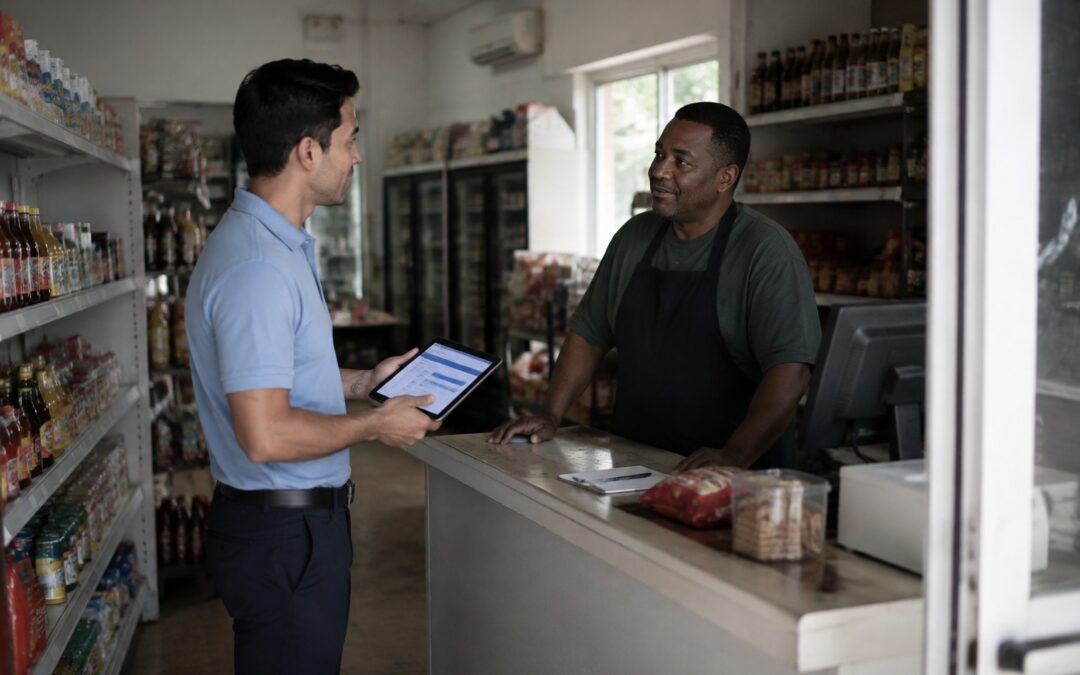
No — AI will not replace field sales reps in the route-to-market work that actually moves product, but it is already replacing what reps used to do around the selling: the reports, the route admin, the photo paperwork, the guesswork about what to pitch. The question “will AI replace field sales reps” gets a cleaner answer from the labor data than from vendor marketing: US employment of wholesale and manufacturing sales representatives is projected to show little or no change through 2035, even as AI spreads through sales workflows. What changes is the shape of the job. The admin thins out; the conversation with the store owner becomes the whole point.
Will AI Replace Field Sales Reps, or Just Their Paperwork?
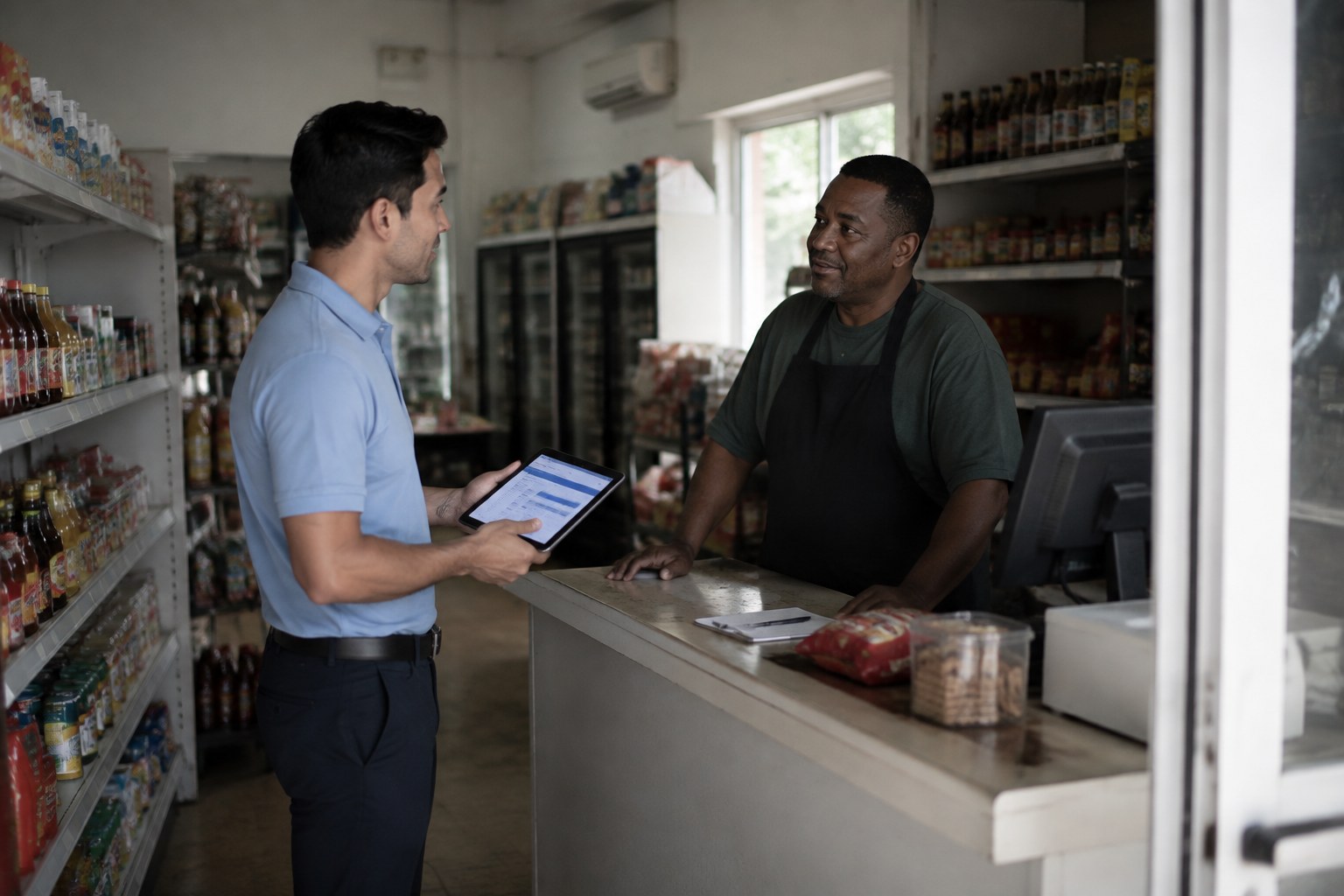
Start with what the paperwork actually costs. In most consumer goods field teams, a rep’s day has two layers: the store work (check the shelf, agree the order, settle the display) and the system work (fill in the visit report, log the photos, update the order, explain last week’s numbers). The second layer is what AI eats first, because it is structured, repetitive, and verifiable.
So will AI replace field sales reps? The honest answer: AI replaces tasks, not people. The U.S. Bureau of Labor Statistics projects little or no change in sales representative employment from 2025 to 2035, with roughly 123,000 openings a year, most from people transferring or retiring. That is the opposite of a profession being automated away. Compare that with telemarketing, where the same outlook tables show steep decline — the jobs that disappear are the ones built on scripted one-way messaging, not on relationships with thousands of small business owners.
| What AI takes over | What stays with the rep |
|---|---|
| Visit reports, KPI write-ups, weekly recaps | Reading the store owner’s real appetite for risk |
| Route planning and re-planning when the day slips | Negotiating an extra facing or a second position |
| Shelf photo checks and compliance scoring | Convincing a hesitant owner to try a new SKU |
| Suggested order baskets and pitch talk-tracks | Trust built over years of reliable deliveries |
| Expense slips, invoice capture, mileage admin | The face-to-face apology and fix when something went wrong |
That table is the whole debate in one view. Ask anyone “will AI replace field sales reps” and this is the honest reply: every row on the left is a task an AI agent for route to market does end to end — generate the report, rebuild the route, score the shelf photo, draft the pitch. Every row on the right fails without a human being in the room. Teams that confuse the two columns end up cutting the wrong thing. If you want to see the task list in checklist form, we published an eight-capability evaluation guide that scores each one.
What Has AI Already Taken Over From Field Sales Reps?
None of this answers the question “will AI replace field sales reps” at the task level, so name the jobs it actually does today. These are real capabilities running in route-to-market platforms, not demos:
- Conversational reporting. A sales manager asks “which twenty stores declined this week and by how much?” in plain language, and an AI chat report returns the answer from live execution data — no dashboard, no analyst queue, no waiting for the Monday file.
- Route optimization. The day’s store sequence is built and rebuilt automatically when a visit runs long or a road is closed, instead of the rep freestyling after the third cancellation.
- Perfect store image recognition. The rep photographs the shelf; AI counts facings, scores share of shelf, checks the display contract — and the rep can appeal a misread, which keeps humans in the loop rather than under the algorithm.
- Replay detection. If a photo is a screen capture or a recycled image, the system flags it. That protects the honest majority of reps from the few who fake visits.
- Sell-in suggestion. Before the rep walks in, AI proposes the basket this specific store is likely to take, with a talk-track to pitch it — so the rep walks in prepared instead of guessing.
- Training and rehearsal. New reps practice objection handling against a simulation pod and get scored before they face a real owner.
Notice the pattern: every one of these removes preparation or paperwork, not persuasion. McKinsey’s 2026 analysis of B2B sales puts it directly — agents do more of the heavy lifting, while sellers spend more time building trust and shaping solutions. That is the direction of travel for consumer goods field teams too.
What AI Cannot Do at the Store Counter
Here’s the thing people underestimate: the hard part of a field rep’s job is not remembering the price list. It is reading a human being who is busy, price-sensitive, and has three competing beverage reps in the same week.
AI cannot sit across the counter and notice that the owner is worried about a slow-moving SKU from last month. It cannot negotiate the give-and-take where the owner takes one extra display position in exchange for a faster restock promise. It cannot repair trust after a delivery failure — and in traditional trade, trust is the asset the whole route to market runs on. A global brewer that digitized its merchandising agreements found the AI could verify every display within minutes, but the agreement only got signed in the first place because a rep had driven out, walked the store, and made the case in person.
So will AI replace field sales reps at the counter? The store owner’s answer is telling: owners consistently prefer to verify AI-generated recommendations with a person they know. The recommendation can come from a model; the yes comes from a relationship.
Which field sales skills matter more now than before
Because the real question behind “will AI replace field sales reps” is which skills appreciate, watch the ones the market starts paying for:
- Selling time discipline. If AI hands back two hours a day, the reps who win are the ones who reinvest it in visits, not in a longer lunch.
- Negotiation with local context. Knowing which argument lands in this neighborhood, with this owner, this season.
- Data fluency. Reps who can challenge a bad AI suggestion — “the model wants 12 cases but this store always stalls on flavor X” — make the whole system smarter, because their corrections retrain it.
- Coaching receptiveness. Teams that rehearse in AI training pods ramp new hires in weeks; the reps who treat feedback as fuel move fastest.
How to Reposition a Field Team for AI Without Fear
Most leaders who ask “will AI replace field sales reps” are really asking what to tell the team on Monday. Four moves, in order:
- Frame AI as admin removal, not surveillance. Announce it that way, and mean it. The first capabilities you deploy should visibly delete paperwork — reports, expense slips, photo admin — before anything that scores people.
- Pick two time-sink capabilities first. Conversational reporting and route optimization are the usual pair; both give time back within the first week, which builds goodwill for the shelf-recognition rollout later.
- Keep the human in every loop. Appeal workflows on image recognition, confirm-before-send on suggestions. Reps who can correct the AI trust it; reps who can only obey it route around it.
- Measure time back, not heads cut. Track selling-time share and productive visits per day. If the numbers rise while headcount stays flat, you have the honest version of the AI story — growth without layoffs.
Frequently Asked Questions
Q1: Will AI replace field sales reps in the next five years?
The labor data says no. The BLS projects little or no change in sales representative employment through 2035, and the parts of the job AI absorbs — reports, route admin, photo checks, expense capture — are the parts reps mostly hate anyway. What actually happens looks more like a smaller admin load per rep and larger territories covered better. Teams using AI copilots in the field keep people in the store and let models handle the desk work.
Q2: Which parts of a field rep’s job does AI already do?
Conversational reports (ask questions, get answers from live data), route planning and re-planning, shelf photo recognition with compliance scoring, replay detection on submitted photos, suggested order baskets with pitch talk-tracks, order and invoice recognition, and simulation-based sales training. All of these exist today in route-to-market platforms; none of them replaces the counter conversation.
Q3: What can AI not do in field sales?
It cannot build trust with a store owner, negotiate an extra display position, read hesitation, repair a relationship after a delivery failure, or make an owner feel like a priority rather than a line in a route. Those are precisely the moments where orders get bigger and loyalty gets locked in — which is why the counter conversation remains a human job.
Q4: Won’t AI just mean companies hire fewer reps?
Some re-shaping is likely at the edges, but the dominant pattern in route to market is coverage expansion: the same team covering more stores, more frequently, with better data. When a rep’s admin load drops and their hit rate rises, each rep is worth more, not less — which is why “will AI replace field sales reps” and “will AI grow my coverage” usually have opposite answers. Cutting heads while adoption is still early usually costs a company its coverage in exactly the neighborhoods where data is thinnest.
Q5: How should a rep prepare for AI in field sales?
Lean into the parts that appreciate. Learn to challenge AI suggestions with store-level context, because corrections improve the model and make the rep visible as an expert. Use rehearsal tools to sharpen objection handling. And protect the customer relationship — it is the one asset neither the platform nor the model can replicate.
The question “will AI replace field sales reps” usually hides a better one: what should reps stop doing? The data and the field practice agree on the answer — stop typing, stop photographing paperwork, stop guessing. AI handles that layer today, and it does it without touching the only part of the job the store owner actually values. If you want to see what a field team’s day looks like when the admin is gone, eBest’s route-to-market platform is a good place to start, and our customer results show what “give time back to the front line” looks like in practice.
Ready to Digitize Your Route to Market?
Learn how eBest’s integrated SFA, DMS, and TPM platform helps leading CPG brands turn distribution data into competitive advantage.