

AI Agent for CPG Field Sales: The 8-Capability Checklist
An AI agent for CPG field sales should do eight distinct jobs across the route to market: recognize the shelf, guard photo integrity, match and expand outlets, answer manager questions, suggest what to sell, train the rep, read orders and invoices, and audit distributor warehouses. That checklist — not a demo-day chatbot — is the honest yardstick. Nearly half of retail and CPG companies are already using or assessing agentic AI, and most vendors demonstrate one or two of the eight. Score all of them before you shortlist anything, because the capabilities that sound least glamorous are usually the ones that decide whether your data is real.

What Should an AI Agent for CPG Actually Do?
Start from the field day, not from the technology. A rep wakes up, gets a route, drives to a store, checks the shelf, pitches products, takes the order, files the visit, and moves on. A manager wants answers, not dashboards. A distributor’s stock needs verifying. Every one of those moments is a place where an agent either acts or doesn’t — and that is the whole evaluation.
The market pressure is real. Bain’s analysis of AI agents argues that the buying process is collapsing into agent-led research, and NVIDIA’s 2026 retail and CPG survey reports 47% of organizations using or assessing agentic AI. But adoption pressure is exactly why the checklist matters: urgency makes buyers lazy, and lazy buyers buy demos instead of platforms.
A caution on wording before the list: “AI-powered” is not a capability. It is a adjective that costs nothing to print, and it appears on the deck of every vendor in the category. The checklist below only counts a capability when it can be demonstrated on your data, in your market conditions, end to end. Anything that can’t be demoed is a roadmap item, and roadmap items get zero points.
The 8-Capability Checklist for Any AI Agent for CPG
Score each capability 0–2 (absent / partial / demoable with your own data). Anything below 10 out of 16 means the “agent” is a feature, not a platform.
| # | Capability | What it does | Where it acts |
|---|---|---|---|
| 1 | Perfect store image recognition | Counts SKUs and facings, scores shelf share and contract compliance, identifies POSM and special displays from one photo | At the shelf, every visit |
| 2 | Replay / fake-photo detection | Flags reused or screen-captured photos so faked visits can’t pollute execution data | Every photo step |
| 3 | Store matching & expansion | Matches unlisted outlets by similarity score; recommends new stores from map + market data | Territory planning |
| 4 | AI chat report & KPI suggestion | Answers plain-language questions with live execution data; diagnoses weak KPIs and proposes actions | Manager cockpit |
| 5 | AI sell-in suggestion | Generates a store-specific pitch from store profile and local best-sellers | At the counter |
| 6 | AI training & exam | Role-play simulation pods with auto-scoring; adaptive learning paths with measured pass rates | Back office / onboarding |
| 7 | Order & invoice recognition | Reads courier slips and invoices, extracts amounts and dates, validates against addresses and windows | Back office / expense control |
| 8 | AI warehouse audit | Recognizes product types, quantities, and share in distributor warehouses; auto-generates audit reports | Distributor sites |
Capabilities 1–2: The shelf loop and its lie detector
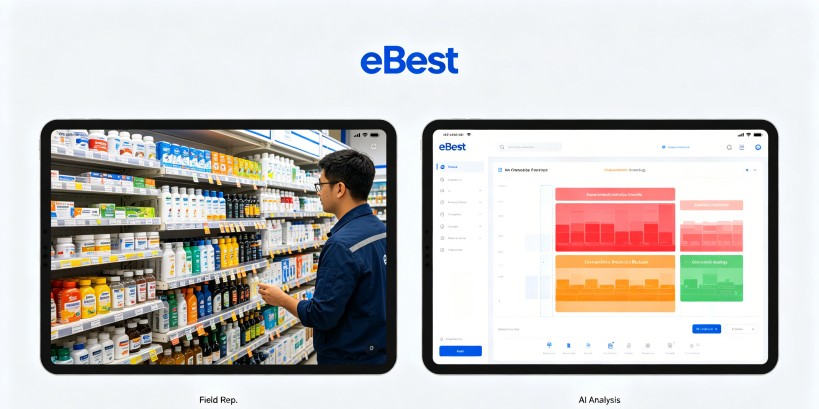
Perfect store image recognition is the capability everyone claims, so test it hard: hand the vendor a photo of your own shelf and watch it count facings, flag a POSM display, and score compliance. Push into the corners too — floor stacks, end caps, column wraps — because the irregular displays are where recognition models actually differ. Then ask the follow-up question almost nobody asks — what happens when the rep says the AI is wrong? A mature AI agent for CPG has an appeal workflow: the rep corrects the misread, the correction is logged, the score updates. That loop does double duty: it keeps reps engaged with the system instead of resentful of it, and it generates exactly the labeled corrections that make the recognition better in your market over time.
And underneath both sits replay detection. It is the least glamorous capability on the list and the most important, because a platform that cannot tell a live shelf photo from a screenshot is a platform whose entire dataset you cannot trust. Every KPI your leadership team reads — visit compliance, shelf share, display execution — inherits whatever the photo layer tolerates. Ask the vendor to attempt a faked submission in the demo and watch what happens.
Capabilities 3–4: Coverage and the manager’s questions
Store matching and big-data expansion decide how complete your outlet universe is. When a rep can’t find a store on the map — and in traditional-trade markets, that’s a daily event — the agent should recommend similar outlets with a similarity score and address, so the visit still gets logged against the right business. On the greenfield side, map data plus market data can point your developers at coverage gaps before competitors find them. On the reporting side, ask the vendor to answer a real question live — “which twenty stores declined this week and by how much?” — and time the answer. A chat report that runs on the live outlet master beats any scheduled dashboard, because it works the way managers think; the best ones go further and suggest what to fix first.
Capabilities 5–8: Sell-in, skills, paperwork, and the warehouse
AI sell-in suggestion is where agents earn their keep commercially: the right basket, pitched with the right talk-track, at the moment the rep is face to face with the store owner. The pitch part matters more than buyers expect — a suggestion without words is a chart, and reps don’t sell from charts. Training and exam capabilities close the skills loop: simulation pods where reps rehearse objection handling and get scored, with adaptive learning paths for the gaps. Order and invoice recognition quietly removes hours of back-office typing every week — courier slips read and validated against addresses and date windows, invoices extracted for reimbursement. And warehouse audit extends the agent’s eyes into the distributor, where a surprising share of “phantom availability” lives: the ERP says stocked, the warehouse shelf says otherwise.
Which Capabilities Matter First — by Role?
If you run sales: start with 5, 1, and 4. Sell-in suggestions move revenue this quarter; shelf recognition protects it; conversational reporting tells you where to push next. Route and training capabilities compound later.
If you run IT or data: start with 2, 8, and 7. Replay detection determines whether the data estate you’re building is worth anything; warehouse audit and document recognition shrink the integration surface with distributors and finance. The shelf loop will get all the demo attention, but the integrity and back-office capabilities are where CIOs earn their keep.
If you run sales operations: start with 3 and 6. Coverage completeness and rep ramp time are the levers you actually own, and both are measurable within a quarter. A territory that gains ten percent real outlets and a rep cohort that ramps in weeks instead of months will fund the rest of the checklist on their own.
How to Run the Checklist With Your Own Data
- List the eight capabilities as scorecard rows. Circulate it to the vendor before the demo so nobody wastes time on theater.
- Demand your data in their demo. Your shelf photos, your order slips, your store list. Canned demo images prove nothing.
- Score 0–2 per capability, live. Partial credit is where most vendors land on 6–8; full marks on 1–5 is the differentiator.
- Probe the failure paths. Wrong recognition, faked photo, ambiguous invoice — what happens next? Appeal workflows and replay detection are the tell.
- Total it and walk away below 10. A platform scoring 14+ across all eight is a platform; a platform scoring 6 is a chatbot with a roadmap slide.
How eBest Maps to the Checklist
All eight are shipped capabilities on eBest’s route-to-market suite, not roadmap promises: perfect store image recognition with facings, POSM, and special displays; replay detection on every photo step; store matching and big-data outlet expansion; AI Chat Report with AI KPI Suggestion for managers; AI Selling Story at the counter; the scenario simulation pod plus AI Training & Exam; order and invoice AI recognition; and AI warehouse audit. They run on one outlet master across SFA, TPM, and DMS, with client deployments across beverage, food, and spirits — Coca-Cola and Carlsberg among the live references. We publish the checklist because we’d rather be scored on all eight than demoed on two.
Frequently Asked Questions
What is an AI agent for CPG field sales?
An AI agent for CPG field sales is software that autonomously executes parts of the route-to-market workflow — planning visits, recommending order baskets, verifying shelf execution from photos, answering manager questions, auditing distributor stock — instead of only recording what reps did. The defining trait is action: the agent takes the next step and logs the result without being prompted at each one.
How many capabilities should an AI agent for CPG have?
Eight covers the full route to market: shelf recognition, photo-integrity detection, outlet matching and expansion, conversational reporting with KPI suggestions, sell-in suggestions, training and exam, order and invoice recognition, and warehouse audit. Vendors typically demo two or three; the back-office and integrity capabilities are where platforms separate from point solutions.
Can an AI agent for CPG detect faked store visits?
The good ones can. Replay detection analyzes each submitted photo for signs it was reused or screen-captured, flags the submission, and lets the rep confirm or retake. Without it, visit-compliance data quietly rots, because a rep under time pressure will always be tempted by yesterday’s photo. Make it a scored checklist item, not an afterthought.
Does an AI agent for CPG work offline?
It must. Rural routes and dense urban markets alike lose connectivity daily, so visits, orders, and photos should queue offline and sync on reconnection. Ask specifically how image recognition behaves without a signal, since the shelf loop is where most of the agent’s value concentrates and where most demos quietly assume perfect 4G.
How do we evaluate an AI agent for CPG vendor quickly?
Use the 8-capability checklist as a scorecard, demand demos on your own data, score each capability 0–2 live, probe the failure paths — wrong recognition, faked photo, ambiguous invoice — and walk away from totals under 10 out of 16. A structured hour like this tells you more than a month of sales calls.
The eight capabilities are not a wish list — they are the operating system of a modern route to market, and the market is moving fast enough that scoring vendors casually is the expensive option. Run the checklist, demand your data in the demo, and let the totals speak. The platform that scores on all eight is the one that will still be acting for you a year from now.
Ready to Digitize Your Route to Market?
Learn how eBest’s integrated SFA, DMS, and TPM platform helps leading CPG brands turn distribution data into competitive advantage.