
CPG Sales Software: How AI Unifies SFA, DMS, and Sell-In
A field manager at a beverage company opens one app in the morning and sees every store visit, every distributor stock level, and every promotion due that day — each one scored and sequenced by AI. That is what good CPG sales software looks like now: not a stack of separate tools, but one connected system where sell-in suggestions, route optimization, and perfect-store checks feed the same live picture. The brands gaining share are the ones that stopped buying point solutions and started running a unified execution layer across SFA, DMS, and sell-in.
Why Most CPG Sales Software Stacks Fail
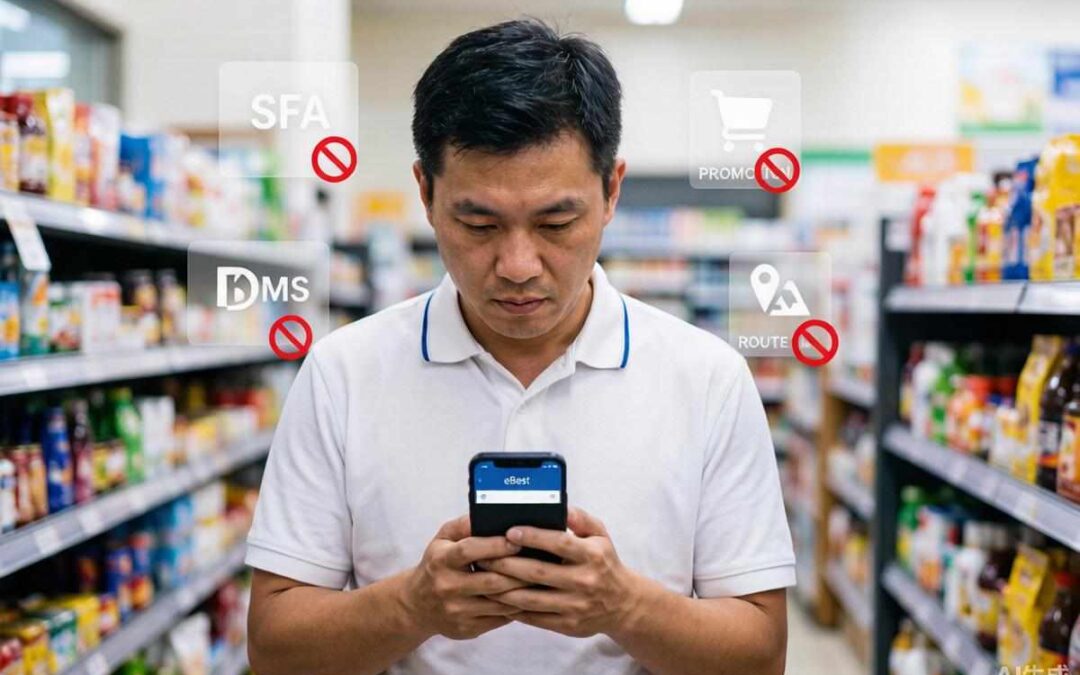
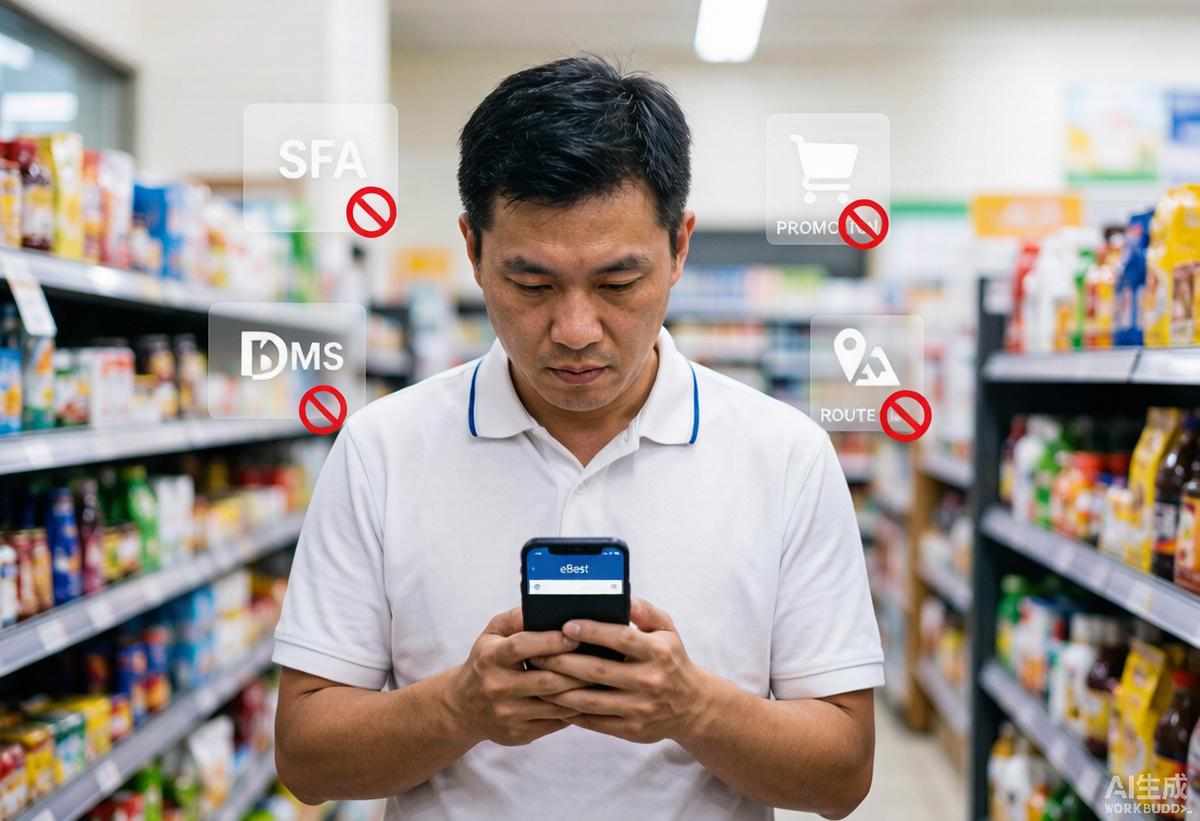
Walk into almost any consumer-goods company and you’ll find the same sprawl: an SFA tool here, a DMS over there, a trade-promotion module bolted on, a route-planning app someone bought at a conference, and a “field intelligence” dashboard nobody opens after week two. Each tool works in isolation. The rep logs a visit in one system, the distributor clerk updates stock in another, and the promotion manager plans trade spend in a third. None of them agree on what actually happened at the shelf yesterday.
That disconnect is exactly why so much CPG sales software gets labeled “shelfware” within a year. The point of this software was never to collect more logins — it was to move product off the shelf and onto the kitchen table. When the systems don’t share a single view of the store, the AI inside each one is only as smart as its own narrow slice of data. A sell-in model that can’t see the shelf is guessing. A route planner that can’t see the promotion is sequencing by habit.
NielsenIQ’s retail-execution research keeps showing the same thing: execution consistency — not promotion size — protects share in volatile categories. Software that fragments execution across five portals quietly undermines exactly the consistency that wins.
What Unified CPG Sales Software Actually Means
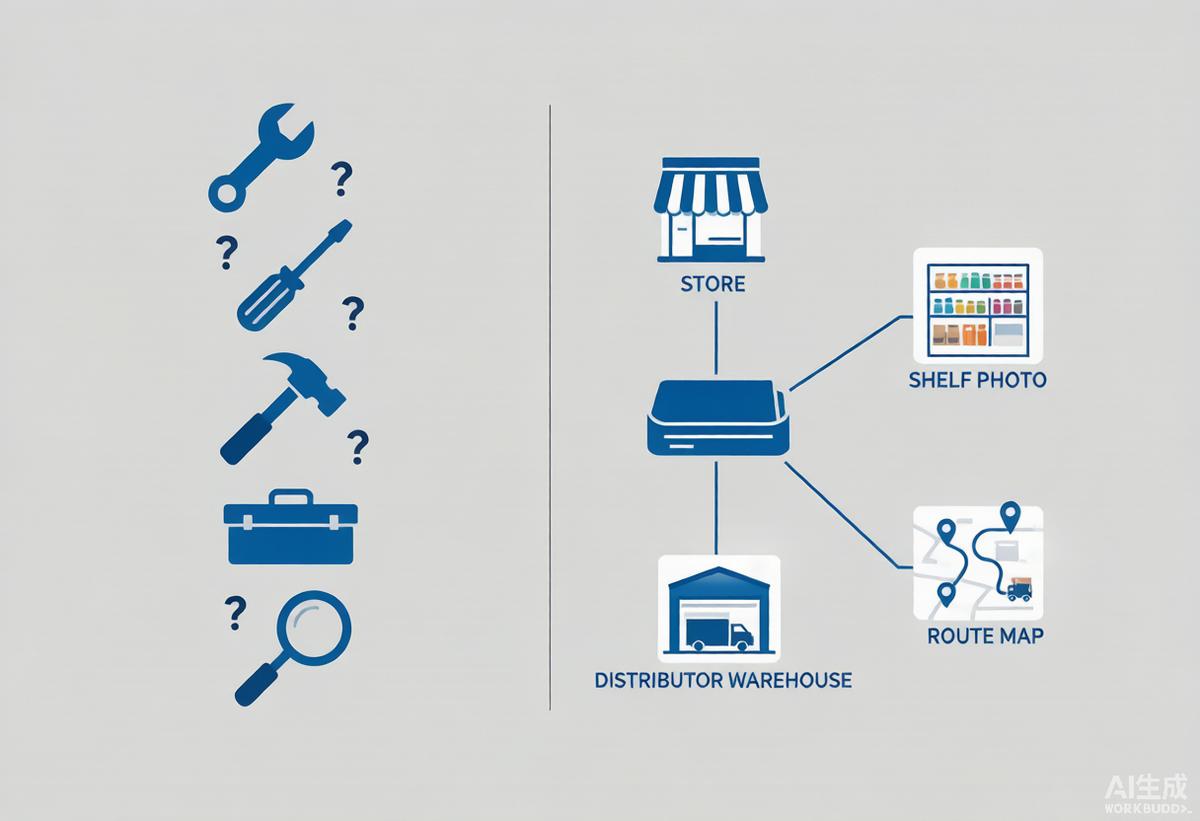
“Unified” gets used loosely, so let’s be precise. Unified CPG sales software is one data model, one mobile app in the rep’s hand, and one shared record of every store, shelf, and distributor. A sell-in suggestion, a route plan, and a shelf audit all read from the same store profile. When the rep photographs the shelf, the perfect-store score updates the same record the promotion manager and the distributor clerk can see.
This is different from “integrated,” where five tools are stitched together with middleware and still argue about whose data is right. Integration reduces switching cost. Unity removes the argument. For field teams, that distinction is the difference between a tool they tolerate and a tool they rely on.
What Should CPG Sales Software Actually Deliver?
Skip the feature checklist for a moment and start with the outcome. Good CPG sales software should do four things reliably: tell the rep which stores to visit and why, tell them what to pitch in each store, confirm the shelf matches the plan, and show headquarters what actually happened — without a three-week lag.
If a platform can’t do those four, the rest is decoration. Yet most buying decisions still start with a capability grid rather than a workflow question. The grid looks complete; the workflow still leaks.
Here’s the contrast that matters:
| Capability | Siloed tools | AI-unified CPG sales software |
|---|---|---|
| Store data | Separate per tool, often stale | One shared, live store/shelf/distributor record |
| Sell-in | Generic order pad | AI sell-in suggestion built for that store |
| Route | Geography only | AI route optimization sequenced by revenue |
| Shelf check | Manual, infrequent | Perfect store image recognition from a photo |
| Data trust | Easy to fake | Replay / fake-photo detection at every step |
| Reporting | Monthly deck, always late | AI Chat Report turns a question into an answer |
The right column is not a bigger toolkit. It’s the same toolkit wired to one brain.
How to Choose CPG Sales Software That Pays Off
Choosing well is less about the longest feature list and more about three tests you can run in a demo.
Start With the Workflow, Not the Model
Vendors love to lead with the model. Resist it. Ask to see the store visit first: does the AI appear inside the visit app, or does the rep have to jump to a separate assistant? If adoption depends on opening a second tool, it dies in week three. Useful CPG sales software hides the AI inside the work, so the rep just sells.
Is Your CPG Sales Software Really Connected — or Just Integrated?
This is the quiet dealbreaker. Ask the vendor: when a rep photographs a shelf, does the promotion manager see the perfect-store score the same day? If the answer is “after the nightly sync” or “with our integration add-on,” you’re buying silos with a ribbon. True CPG sales software shares the record in real time, because a score nobody sees by close of business is a score nobody acts on.
Insist on an Integrity Layer
If reps can reuse last month’s shelf photo, every downstream model learns from fiction. eBest’s replay / fake-photo detection flags screen-captured or recycled images at each photo step, so the data the AI trains on stays honest. Most “AI-powered” vendors never mention this, and it’s the reason field data stays believable at scale. Make it a hard requirement, not a nice-to-have.
How eBest Builds CPG Sales Software That Ships
eBest runs SFA, DMS, TPM, and DSD on one mobile-first platform, so every AI capability reads the same store, shelf, and distributor stock. That’s what lets the named features actually compound instead of competing for data.
The capabilities aren’t a slide — they’re on the rep’s device today:
| eBest AI capability | What it does in the field |
|---|---|
| AI sell-in suggestion | Builds a store-specific pitch and basket during the visit |
| AI route optimization | Sequences the day by revenue potential, not just distance |
| Perfect store image recognition | Scores the shelf from a photo, even offline |
| Replay / fake-photo detection | Flags reused or screen-captured images at the source |
| AI Chat Report | Turns a plain-English question into an execution report |
| AI warehouse audit | Counts distributor stock from photos, flags gaps early |
Leading consumer-goods brands run their field sales and distribution on eBest across markets; client success stories show how the loop works in practice, including a large beverage distributor that unified more than 10,000 reps onto one RTM record. The point isn’t that eBest “has AI” — it’s that the AI is named, testable, and wired to the same data the rep touches. For the foundational layer, start with SFA software and the distributor management system, then layer trade promotion management on top.
How to Consolidate Your CPG Sales Software Stack in 5 Steps
You don’t rip everything out on Monday. You consolidate toward one connected record in stages:
- Map where execution data lives today. List every system that touches a store visit, a distributor stock count, or a promotion. Note the gaps between them.
- Pick one high-frequency workflow as the anchor. The store visit is the best first target — it happens daily and produces both photos and orders.
- Embed the AI inside that workflow. Put sell-in suggestions and shelf recognition in the visit app. If reps must open a separate assistant, adoption stalls.
- Turn on the integrity layer from day one. Enable replay / fake-photo detection so the data stays honest as you migrate.
- Measure one named KPI and expand. Track perfect-store score or pitch acceptance in the pilot, then roll the pattern to route optimization, warehouse audit, and promotion analytics.
Gartner’s coverage of AI in sales and McKinsey’s CPG research both point the same way: the wins come from connected execution, not from isolated automation. The platform that wins is the one your reps actually open.
CPG Sales Software FAQ
Q1: What is CPG sales software?
CPG sales software is the system consumer-goods companies use to run field sales, distribution, and trade promotion — planning store visits, capturing orders, auditing shelves, and managing distributor stock. The strongest versions unify SFA, DMS, and sell-in on one connected data model so every capability shares the same store record, instead of running as separate tools that never agree on what happened at the shelf.
Q2: How do you choose CPG sales software that won’t become shelfware?
Test it in a demo against three things: does the AI live inside the rep’s visit workflow (not a separate assistant)? Does it have a data-integrity layer like replay / fake-photo detection so field photos can’t be faked? And does one connected data model update the promotion manager and distributor clerk in real time? If any answer is “no” or “with an add-on,” you’re buying silos. Choose the platform that passes all three.
Q3: What AI capabilities should CPG sales software include?
The capabilities that move revenue are narrow and named, not vague “AI-powered” labels. Look for AI sell-in suggestion (store-specific pitch), AI route optimization (revenue-sequenced visits), perfect store image recognition (shelf scored from a photo, offline), replay / fake-photo detection (anti-spoofing), AI Chat Report (natural-language execution reports), and AI warehouse audit (distributor stock from photos). eBest ships all six on one mobile-first platform.
Q4: Which CPG segments benefit most from unified sales software?
The biggest gains show up where retail is most fragmented — beverage, packaged food, and personal care across traditional trade and emerging markets. Those environments have thousands of small outlets, heavy promotion activity, and thin visibility, which is exactly where shared shelf, route, and distributor data compounds fastest. Large, structured accounts benefit too, but the fragmented tail is where unified CPG sales software closes the widest gap.
Q5: Is CPG sales software with AI worth the switch if we already run SFA and DMS separately?
Usually yes, if the two systems don’t share a live store record. The cost of staying separate is paid in execution lag — promotions planned without shelf reality, routes built without revenue context. Teams already on one platform can often activate named AI capabilities as configuration rather than a rebuild, which keeps the switch low-risk. The expensive path is the standalone proof-of-concept that never connects to execution data.
CPG sales software earns its keep the day the rep stops juggling logins and starts trusting one screen — the shelf is scored from a photo, the pitch is built for that store, the route is planned for revenue, and headquarters sees it before the week ends. The platform you want is the one your field team opens without being told. Request a demo to watch the capabilities run on a real rep’s device, or explore how eBest’s SFA software and distributor management system put a unified execution layer to work.
Ready to Transform Your Distribution Network?
Discover how an AI-powered distributor management system can help your CPG company eliminate stock-outs, optimize inventory across multi-tier networks, and protect revenue.