
Agentic AI for CPG Sales: The 2026 Deployment Guide
Quick Answer
Agentic AI for CPG sales deploys autonomous, goal-driven assistants that help field reps plan visits, generate store-specific pitches, and verify shelf execution in real time. Unlike narrow voice-only call bots, a complete agentic stack closes the loop between the rep, the shelf, and the back office — augmenting people rather than replacing them.
Introduction
Agentic AI CPG has moved from conference demo to frontline reality in 2026. Search interest for AI agents in CPG selling rose roughly 180% year over year, and industry research shows about half of retail and CPG organizations are already using or evaluating agentic AI. Gartner frames this as a shift from assistive to agentic systems, where the assistant initiates actions rather than waiting for prompts.
Yet most vendors ship a narrow slice — typically a voice agent that books calls. The brands winning route-to-market are deploying agentic AI CPG assistants that do far more: they recommend what to sell at each store, recognize the shelf from a photo, and surface the next best action before the rep leaves the aisle.
This guide explains how CPG sales and IT leaders should deploy agentic AI as a co-selling assistant in 2026, why a full stack beats a voice-only bot, and how eBest’s human-plus-AI model closes the loop that single-purpose agents leave open.
Why Agentic AI CPG Sales Is the 2026 Inflection Point
The biggest shift this year is not that AI can talk to a customer — it is that AI can act across the entire route-to-market without waiting for a human to copy results between systems. Because field selling, distribution and promotion are one continuous motion, an assistant that only handles the conversation leaves the most valuable work — execution at the shelf — untouched.
Consider what happens when a rep finishes a call. A voice agent may log the outcome. However, the plan, the order, the shelf photo and the distributor stock still live in four different places. As a result, the “insight” the agent produced never reaches the shelf where revenue is won. Agentic AI CPG changes this by treating the agent as one node in a connected loop, not a standalone chatbot.
The Coca-Cola ASEAN Signal
Coca-Cola’s ASEAN organization going live with a voice agent is the clearest proof point that CPG giants now treat agentic selling as core infrastructure. When a bellwether of this scale commits, the rest of the category follows. Moreover, it raises the bar: every CPG sales leader now needs a position on agentic AI, not just a pilot.
Agentic AI CPG vs Voice-Only Agents: Why the Shelf Loop Matters
A prominent voice-agent vendor now live at Coca-Cola ASEAN handles the call, not the shelf. Therefore its agent can summarize a conversation but cannot tell you whether the promotion actually reached the shelf, whether the facing count dropped, or whether the store profile was matched correctly. For CPG, the shelf is the source of truth. An agent that never sees the shelf is only halfway to the result that matters.
Three Capabilities That Define Real Agentic AI CPG
First, the AI Agent itself must act as a co-selling assistant — planning the visit, surfacing the store context, and prompting the next step. Second, AI sell-in suggestion (AI Selling Story) must generate a store-specific pitch during the visit. Third, perfect store image recognition must confirm shelf execution from a photo. When these three run together, the agent becomes a closed loop rather than a talking head.
What Is Agentic AI CPG Sales?
Agentic AI for CPG sales is a system of autonomous, goal-driven assistants embedded in the field sales workflow. Rather than a single chatbot, it is a connected set of capabilities that share one outlet master and one data model across SFA, DMS, TPM and DSD. The agent’s job is to move the outlet forward: recommend the next action, generate the pitch, capture the shelf, and push the result into distribution and promotion.
What separates real agentic AI CPG from a retrofitted CRM plug-in is the shelf loop. A generic assistant can draft an email. A CPG agent must recognize a shelf, score compliance, and trigger a replenishment when facing drops. That requires AI trained on the physical retail world — thousands of small outlets, offline coverage, and merchandising reality at the last meter.
How Do You Deploy Agentic AI CPG Assistants in 2026?
Deploying agentic AI CPG should follow a disciplined rollout, not a big-bang rip-and-replace. The five steps below map to the failure modes above, so they double as a scorecard during vendor evaluation.
1. Start With the Visit, Not the Call Center
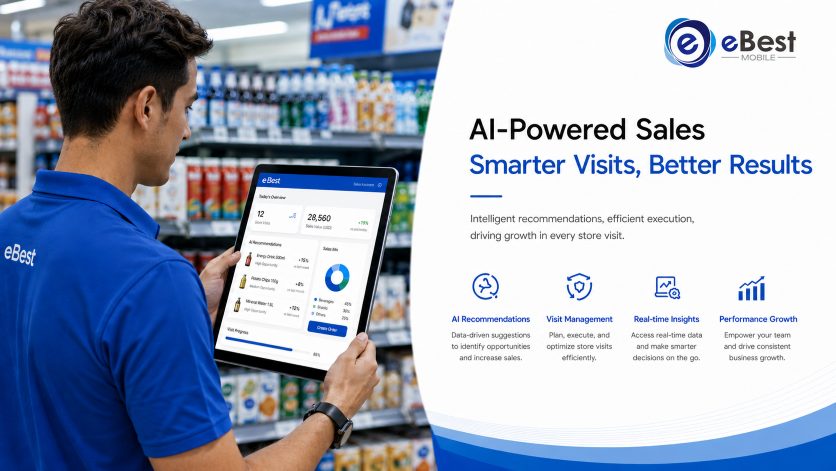
Anchor the agent to the store visit, where execution happens. Because the agent’s recommendations are only as good as the outlet context it sees, begin by connecting it to the SFA visit plan and the outlet profile. A rep who opens the app should immediately see the agent’s suggested sequence for the day, the stores at risk, and the promotions in window. This is why eBest’s agent lives inside the SFA product page workflow rather than as a separate bot.
2. Close the Shelf Loop With Perfect Store Recognition
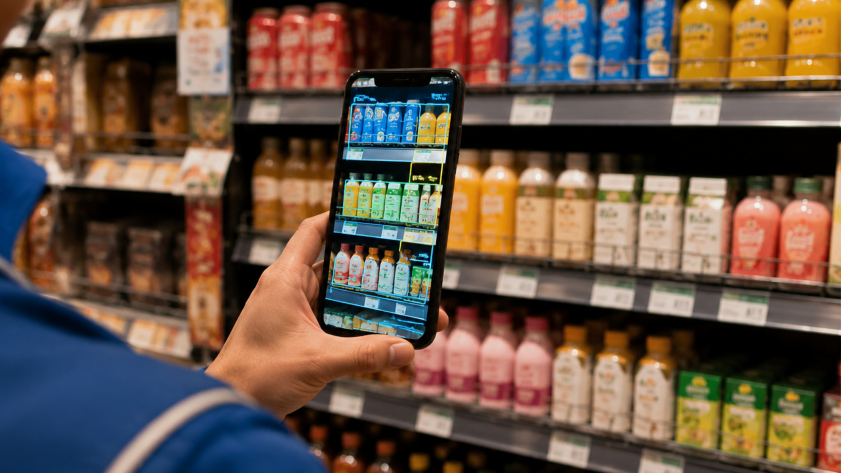
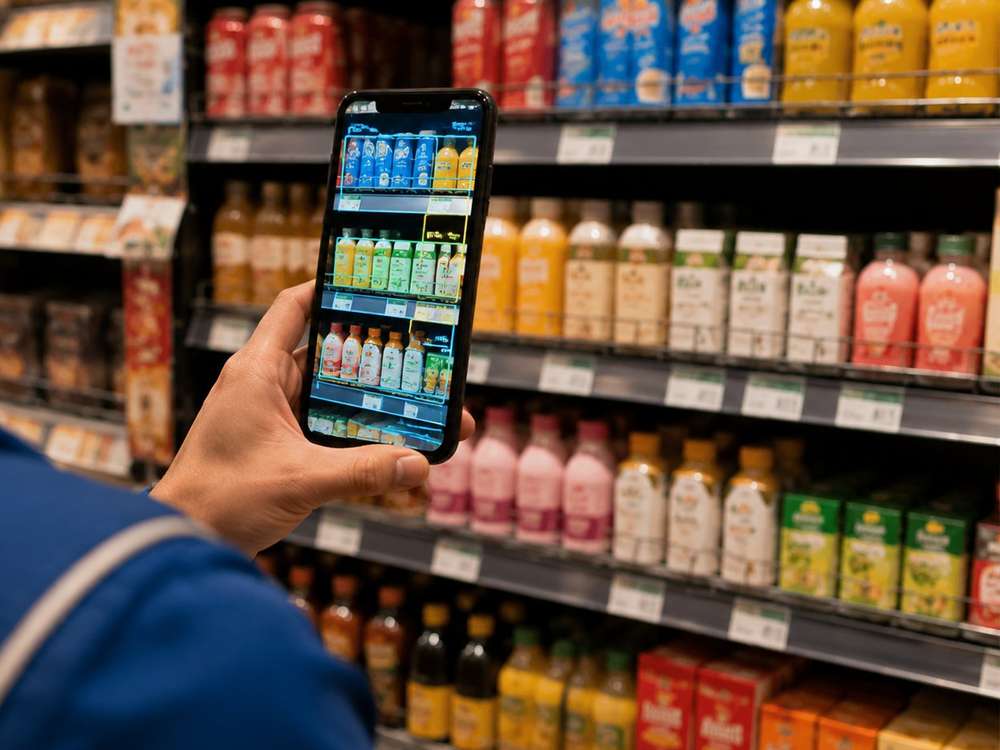
Insist the agent can see the shelf. Perfect store image recognition lets a rep photograph a shelf and receive SKU-level facings, shelf-share percentage and POSM compliance in seconds, with a human-in-the-loop appeal workflow when the model is uncertain. NielsenIQ shelf-share research shows execution consistency — not promotion size — protects share in volatile categories, so closing the shelf loop is where agentic AI CPG pays for itself.
3. Generate Store-Specific Pitches With AI Sell-In Suggestion
Generic pitch scripts waste the visit. AI sell-in suggestion (AI Selling Story) combines the outlet profile with local best-sellers to generate a store-specific pitch during the call. Therefore the rep walks in with the right assortment and the right talk-track, not a one-size-fits-all deck. This capability is concrete and testable in a demo — a clear way to separate real AI from a vague “AI-powered” label.
4. Keep a Human in the Loop
The winning model is human plus AI co-selling, not “the end of the field rep.” Because shelf conditions, local relationships and store politics still need judgement, the agent should recommend and the rep should decide. Furthermore, eBest’s replay / fake-photo detection protects visit authenticity by flagging screen-captured or reused images at every photo step — a trust layer most vendors never address.
5. Connect Agent Output to Distribution and Promotion
An assistant that cannot trigger the next action is a dashboard with extra steps. Therefore wire agent output into DMS for distributor stock and into TPM for promotion measurement. When the agent flags a facing drop, the distributor sees the gap and the promotion team sees compliance in the same system. McKinsey research on CPG digital transformation links this integrated execution to meaningful productivity gains.
How eBest Delivers Agentic AI CPG Sales
eBest Mobile delivers agentic AI CPG as one unified, mobile-first route-to-market system spanning SFA, DMS, TPM, DSD and B2B ordering — with AI embedded across the full chain. Leading consumer goods brands run field sales and distribution on eBest across diverse markets; Wall’s and Mondelēz, for example, operate unified SFA plus AI in production. What makes it distinctive is the depth and breadth of named, scene-specific AI.
The Full Agentic AI CPG Capability Stack
On the visit side, the AI Agent plans and prompts, AI sell-in suggestion generates the pitch, and perfect store image recognition scores the shelf. For data integrity, replay / fake-photo detection flags reused images at every photo step. On the analytics side, AI Chat Report turns a natural-language question into an instant execution report via text-to-SQL, and AI KPI Suggestion surfaces the specific actions that will move a lagging metric. Finally, AI warehouse audit automatically recognizes products and quantities on distributor shelves to generate compliance reports, and AI route optimization sequences visits so high-priority outlets are covered more often.
In short, eBest treats agentic AI as a set of named, testable capabilities embedded in daily workflow — not a vague promise. Real-world deployment patterns are summarized on our client success page.
Frequently Asked Questions
Q1: What is agentic AI for CPG sales?
Agentic AI for CPG sales is a system of autonomous, goal-driven assistants embedded in the field sales workflow. Rather than a single chatbot, it connects the visit, the pitch, the shelf photo and the distributor stock on one outlet master, so the agent can recommend and trigger the next best action for a specific store. The defining feature versus a generic assistant is the shelf loop: the agent sees and verifies execution at the shelf, not just the conversation.
Q2: How is agentic AI different from a voice or call AI agent?
A voice agent handles the call — it can book meetings and summarize conversations. Agentic AI CPG also handles the shelf: it recognizes facings, scores compliance, matches the store profile, and pushes results into distribution and promotion. Because revenue in CPG is won at the shelf, an agent that never sees the shelf captures only half the value. The difference is the closed loop between rep, shelf and back office.
Q3: Which AI capabilities should a CPG agent include, and does eBest offer them?
Effective agentic AI CPG should include named, scene-specific capabilities rather than a generic label. eBest offers the AI Agent co-selling assistant, AI sell-in suggestion (AI Selling Story) for store-specific pitches, perfect store image recognition for shelf scoring, replay / fake-photo detection for visit integrity, AI Chat Report for natural-language analytics, AI KPI Suggestion for improvement actions, AI warehouse audit for distributor compliance, and AI route optimization for visit sequencing — all testable in a demo.
Q4: Will AI agents replace field sales reps?
No. The proven model is human plus AI co-selling, where the agent recommends and the rep decides. Shelf conditions, local relationships and in-store dynamics still require human judgement, so the agent augments productivity rather than removing the rep. In practice, agents handle routine analysis and next-best-action prompts, freeing reps to focus on relationships and complex selling — which is why adoption, not replacement, drives the result.
Q5: How do we deploy agentic AI without disrupting our existing SFA?
Deploy in phases on top of the existing SFA rather than ripping it out. Because eBest’s agent lives inside the same mobile system as SFA, DMS, TPM and DSD, teams can start with visit planning and sell-in suggestion, then layer perfect-store recognition and analytics. An offline-first architecture protects data capture in basements, rural towns and crowded markets where connectivity drops, so the rollout works on a real working day from day one.
Q6: What is AI for CPG sales?
AI for CPG sales means artificial intelligence embedded in the field-selling workflow: visit planning, store-specific pitch generation (sell-in suggestions), route optimization, shelf photo verification, and natural-language reporting. In practice it acts as a co-selling assistant for reps and a live execution signal for headquarters — not a chatbot that replaces the sales call.
Q7: How does AI for CPG sales differ from a generic voice agent?
A generic voice agent handles the conversation — booking meetings, summarizing calls. AI for CPG sales also handles the shelf: it recognizes facings, scores compliance, matches the store profile, and pushes results into distribution and promotion. Because revenue in CPG is won at the shelf, an agent that never sees the shelf captures only half the value.
Conclusion
- Agentic AI for CPG sales wins when it closes the shelf loop — agent, sell-in suggestion and perfect-store recognition together, not a voice bot alone.
- Human plus AI co-selling outperforms both “replace the rep” and “dashboard with extra steps” models.
- Deploy in phases on a unified, offline-first platform so the agent triggers real downstream actions in distribution and promotion.
Ready to deploy co-selling AI assistants? Explore the SFA product page or book a demo to see the full agentic stack in action.
Ready to Digitize Your Route to Market?
Learn how eBest’s integrated SFA, DMS, and TPM platform helps leading CPG brands turn distribution data into competitive advantage.