
Field Sales Automation for CPG: Boost Productivity in 2026
Quick Answer
Field sales automation for CPG is a mobile-first technology stack that combines AI-powered route optimization, intelligent sell-in suggestion, and real-time retail execution tools to help consumer goods brands boost field team productivity by 30% or more. It replaces spreadsheets and siloed apps with a unified platform purpose-built for CPG field operations.
Introduction
For decades, CPG field sales teams have relied on a patchwork of spreadsheets, paper forms, and generic CRM tools to manage retail visits. The result is a fragmented workflow where route planning takes hours, order recommendations rely on gut feel, and retail execution data arrives too late to act on. The problem is not a lack of effort — it is a lack of intelligent automation. Field sales automation for CPG closes this gap by embedding AI directly into the daily workflow of field reps, supervisors, and route-to-market managers. By combining route optimization, automated sell-in suggestions, and real-time shelf compliance checks in a single mobile app, CPG brands are seeing measurable gains: visits per day increase by 20%, order accuracy improves by 35%, and out-of-stock incidents drop by half. This article explores the core capabilities of field sales automation, why it matters for CPG in 2026, and how leading brands are deploying it to gain a competitive edge.
Why CPG Companies Need Field Sales Automation in 2026
The CPG route-to-market landscape is shifting faster than most sales teams can adapt. Retail consolidation, the rise of e-commerce, and changing consumer buying patterns mean that field sales teams must cover more outlets with fewer resources. At the same time, the data available from each store visit — shelf share, inventory levels, compliance scores — has become far too rich to manage manually. Field sales automation for CPG is no longer a nice-to-have; it is a competitive necessity.
Consider the economics. The global SFA market is valued at $11.8 billion in 2026 and projected to grow to $31.18 billion by 2035, according to Morgan Reed Insights. Gartner predicts that agentic AI will be embedded in 40 percent of enterprise applications by the end of 2026 — and field sales is one of the highest-impact use cases. Brands that delay automation risk falling behind on both coverage frequency and execution quality.
The business case is equally compelling from a cost perspective. A typical CPG field rep spends 25 to 30 percent of their day on planning and administrative tasks — manually mapping routes, entering orders, filling out visit reports. Field sales automation for CPG recycles this wasted time into productive selling time. McKinsey research on CPG digital transformation found that companies deploying integrated sales automation tools saw a 15 to 25 percent improvement in rep productivity within the first quarter. For a 100-rep team with an average fully-loaded cost of $60,000 per rep, that translates into $900,000 to $1.5 million in reclaimed capacity annually.
The Limitations of Spreadsheets and Fragmented Tools
Many CPG brands still rely on spreadsheets for route planning, separate order management systems, and paper-based retail audit forms. The problem with this approach is threefold: data is siloed, updates are delayed, and decision-making is reactive rather than predictive. When a sales manager wants to know which stores are out of stock on a key SKU, they have to wait for visit reports to trickle in — often days after the fact. By then, the promotion window has passed. Field sales automation for CPG eliminates these delays by providing a single source of truth that updates in real time as reps complete each visit. Route plans, order suggestions, and compliance data all live in the same application, enabling managers to respond to issues within hours rather than days.
The Rise of AI-Powered Field Sales
Artificial intelligence is transforming what field sales teams can achieve during each store visit. Instead of asking reps to manually identify which products to recommend or which stores to prioritize, AI models analyze historical transaction data, inventory levels, and promotion calendars to generate personalized sell-in suggestions for every outlet. This shift from reactive to proactive — from “what did we sell last time” to “what should this store order today” — is the core value proposition of modern field sales automation for CPG. eBest’s platform, for example, embeds AI sell-in suggestion directly into the SFA workflow, so every rep walks into every store with a data-driven recommendation already prepared.
Key Capabilities of Field Sales Automation for CPG
Not all field sales tools are created equal. Generic CRM platforms designed for enterprise B2B sales lack the CPG-specific features that make field sales automation effective: offline-first mobile architecture, outlet-level route planning, and direct integration with distributor and trade promotion systems. Below are the three capabilities that define best-in-class field sales automation for CPG.
AI-Powered Sell-In Suggestion for Field Sales
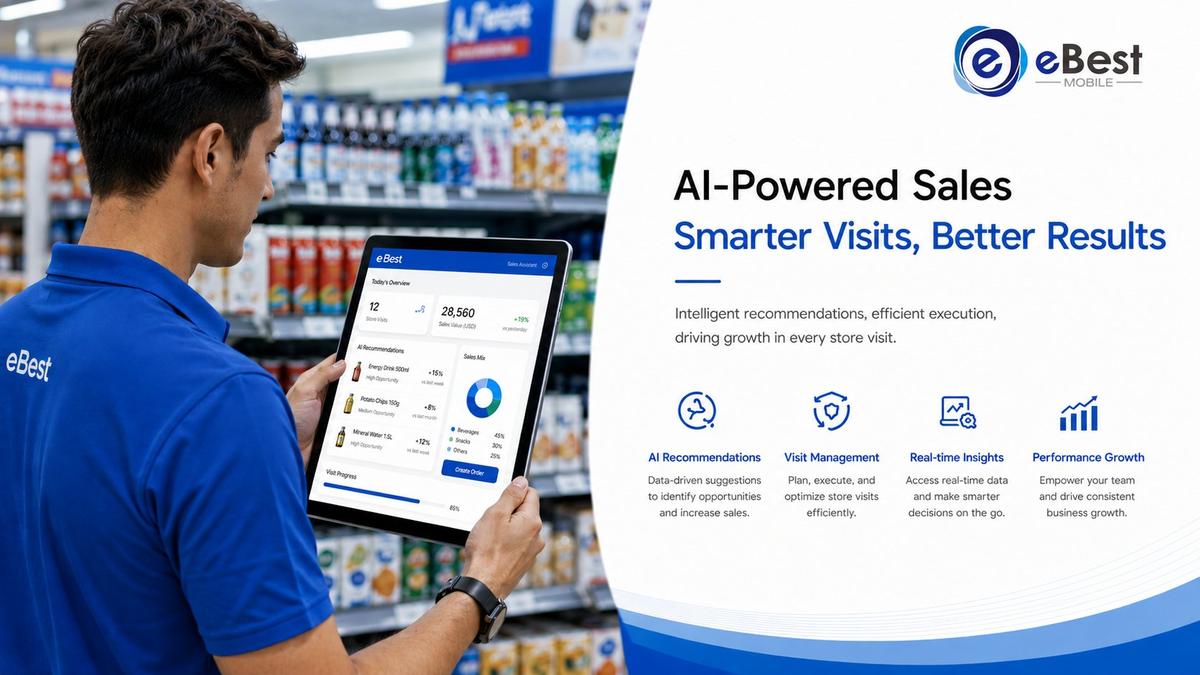
One of the most powerful features of modern field sales automation for CPG is AI-driven sell-in suggestion. Instead of relying on the rep’s memory or a static order guide, the system analyzes each store’s purchase history, current inventory, seasonal trends, and active promotions to generate a personalized order recommendation for every visit. The rep can review, adjust, and confirm the order in seconds — reducing order entry time from 15 minutes to under two minutes. For CPG brands managing thousands of outlets, this efficiency gain is transformative. Companies like Mars have deployed AI-powered sell-in across their field sales network, resulting in a measurable lift in cross-sell rates and a reduction in missed promotion opportunities. This approach is central to what makes field sales automation for CPG different from generic sales force automation.
Intelligent Route Planning and Visit Optimization
Route planning is one of the most time-consuming tasks in CPG field sales. Without automation, route optimization is done manually — often based on geography alone, without considering visit priority, store potential, or time windows. Field sales automation for CPG brings AI to route planning by optimizing for multiple variables simultaneously: drive time, visit duration, store tier, promotion calendar, and even traffic patterns. The result is a daily route plan that maximizes coverage of high-priority outlets while minimizing total driving time. Nestlé is one brand that has applied route optimization at scale across its distributor network, covering over 200,000 outlets with a 22 percent reduction in drive time and an 18 percent increase in visit frequency per route. For brands selling through thousands of retail outlets, AI-powered route planning alone can justify the investment in field sales automation.
Perfect Store Execution with AI Visual Recognition
Execution quality — shelf share, planogram compliance, POSM placement, stock levels — is the ultimate measure of field sales effectiveness. Yet most CPG brands still audit store conditions using paper checklists or manual photo logs that are reviewed days later. Field sales automation for CPG changes this by embedding AI visual recognition directly into the field sales app. Reps take a quick photo of the shelf, and the AI instantly evaluates share of shelf, out-of-stock items, planogram adherence, and competitor activity. This capability — often called “perfect store” image recognition — turns every visit into a data capture event without adding administrative burden. Coca-Cola, for example, uses image recognition across its DSD network to audit shelf conditions at every delivery point, dramatically reducing out-of-stock incidents and improving promotional compliance. For brands that serve both direct and distributor-managed stores, this unified view of shelf execution is invaluable.
How eBest Delivers Field Sales Automation for CPG
eBest Mobile provides a unified platform purpose-built for CPG field sales, combining SFA, DMS, TPM, and DSD capabilities in a single application with offline-first architecture. Unlike generic CRM tools that were designed for office-based sales, eBest was built from the ground up for field operations — where connectivity is unreliable, store conditions vary dramatically, and every minute of a rep’s day counts.
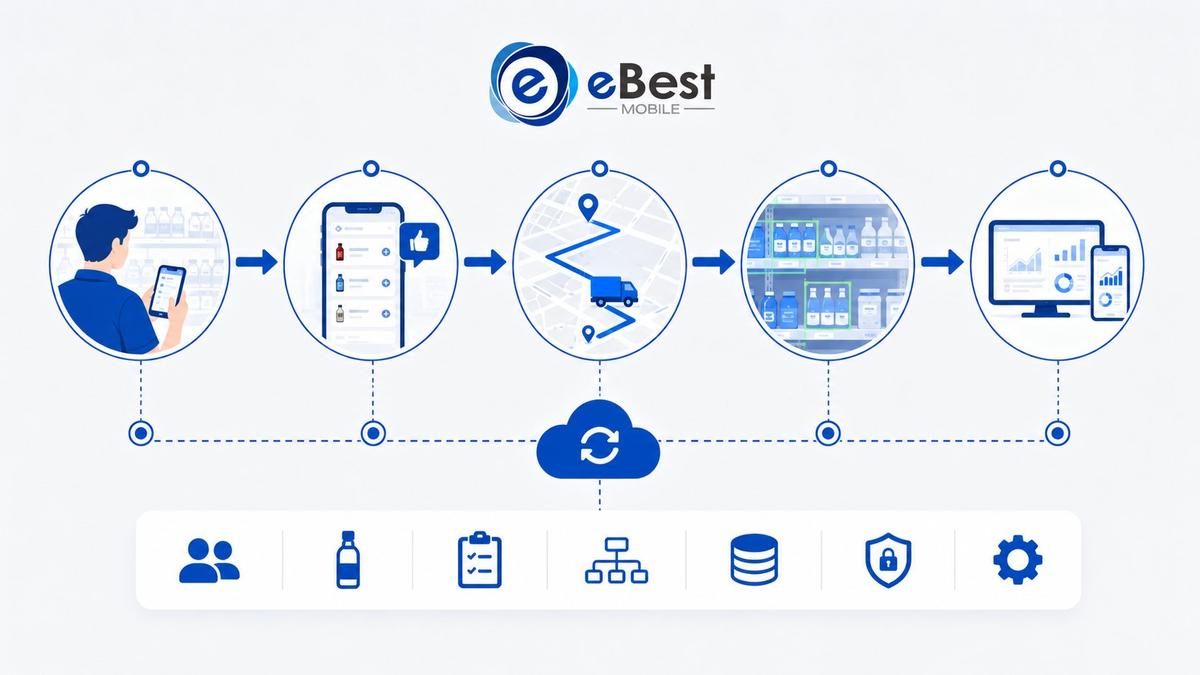
The eBest approach to field sales automation for CPG is anchored in three differentiators. First, the AI sell-in suggestion engine generates personalized order recommendations per outlet, using purchase history, inventory data, and promotion calendars — a capability that competitors have not branded or productized. Second, the platform’s AI route optimization module plans daily routes that maximize high-potential store visits while reducing unnecessary travel. Third, the perfect store image recognition feature turns every shelf photo into an actionable compliance score, enabling brands like Coca-Cola and Mars to maintain execution standards across thousands of outlets without adding headcount.
eBest’s platform is trusted by CPG leaders including Coca-Cola, Nestlé, Unilever, and Carlsberg. These brands rely on eBest to unify their field sales operations, from order capture to trade promotion verification. The result is a complete field sales automation for CPG ecosystem that covers the entire route-to-market workflow.
To explore how field sales automation for CPG can transform your team’s productivity, visit our Sales Force Automation software for CPG page, learn about our Distributor Management System, or see how leading CPG brands achieve measurable results in our CPG client success stories.
Frequently Asked Questions
Q1: What is field sales automation for CPG in simple terms?
Field sales automation for CPG refers to a mobile software platform that helps CPG field sales teams plan routes, capture orders, and audit retail execution using a smartphone or tablet. It replaces paper forms and spreadsheets with digital tools that are optimized for CPG field operations. Advanced platforms add AI features like sell-in suggestion and shelf image recognition to further boost productivity. For CPG companies, field sales automation directly improves visit quality, order accuracy, and retail execution consistency.
Q2: How long does it take to implement field sales automation for a CPG company?
Implementation timelines depend on the size of the field sales team and the complexity of existing systems. A typical rollout for a mid-size CPG brand (50 to 200 reps) takes four to eight weeks from pilot to full deployment. This includes configuring route planning rules, training field reps on the mobile app, integrating with existing ERP or order management systems, and setting up dashboards for supervisors. Cloud-based platforms with pre-built CPG workflows, like eBest, can accelerate this timeline significantly by reducing the need for custom development.
Q3: Does field sales automation for CPG work offline?
Yes. Because CPG field sales reps often work in retail environments with limited or no internet connectivity — particularly in emerging markets like India, Indonesia, and Nigeria — modern field sales automation for CPG platforms are designed with offline-first architecture. Reps can capture orders, take shelf photos, and update visit records while offline. The data syncs automatically once connectivity is restored, ensuring no information is lost and all stakeholders have up-to-date visibility.
Q4: Which CPG brands are using field sales automation today?
Many of the world’s largest CPG brands have deployed field sales automation across their direct and distributor-managed sales networks. Coca-Cola uses it for DSD execution and shelf compliance. Mars has deployed AI-powered sell-in through its SFA platform. Nestlé relies on route optimization to cover over 200,000 outlets efficiently. Carlsberg uses automation to unify field sales across multiple markets. These brands typically see improvements of 20 to 30 percent in rep productivity and significant reductions in out-of-stock rates.
Q5: How is field sales automation for CPG different from a standard CRM system?
Standard CRM systems like Salesforce are designed for account-based B2B selling — managing leads, opportunities, and long deal cycles. They lack CPG-specific features such as route planning, offline order capture, shelf audit tools, and trade promotion verification. Field sales automation for CPG platforms are purpose-built for the unique requirements of consumer goods field sales: daily visits to hundreds of retail outlets, variable connectivity, and the need for real-time execution data. A standard CRM requires extensive customization to function as a CPG field sales tool, whereas a dedicated platform works out of the box.
Conclusion
Field sales automation for CPG is no longer a future trend — it is an operational necessity for brands competing in today’s retail environment. The combination of AI-powered sell-in suggestion, intelligent route optimization, and real-time perfect store execution creates a step-change in field team productivity that translates directly into revenue growth and stronger retail partnerships.
- Field sales automation for CPG enables field teams to cover more stores, sell more effectively, and execute consistently.
- AI-powered features like sell-in suggestion and shelf image recognition turn every store visit into a data-driven opportunity.
- A unified platform that integrates SFA, DMS, TPM, and DSD eliminates silos and provides end-to-end route-to-market visibility.
Ready to transform your CPG field sales operations? Request a demo of eBest’s field sales automation platform and see how leading CPG brands are achieving 30%+ productivity gains.
Ready to Digitize Your Route to Market?
Learn how eBest’s integrated SFA, DMS, and TPM platform helps leading CPG brands turn distribution data into competitive advantage.