
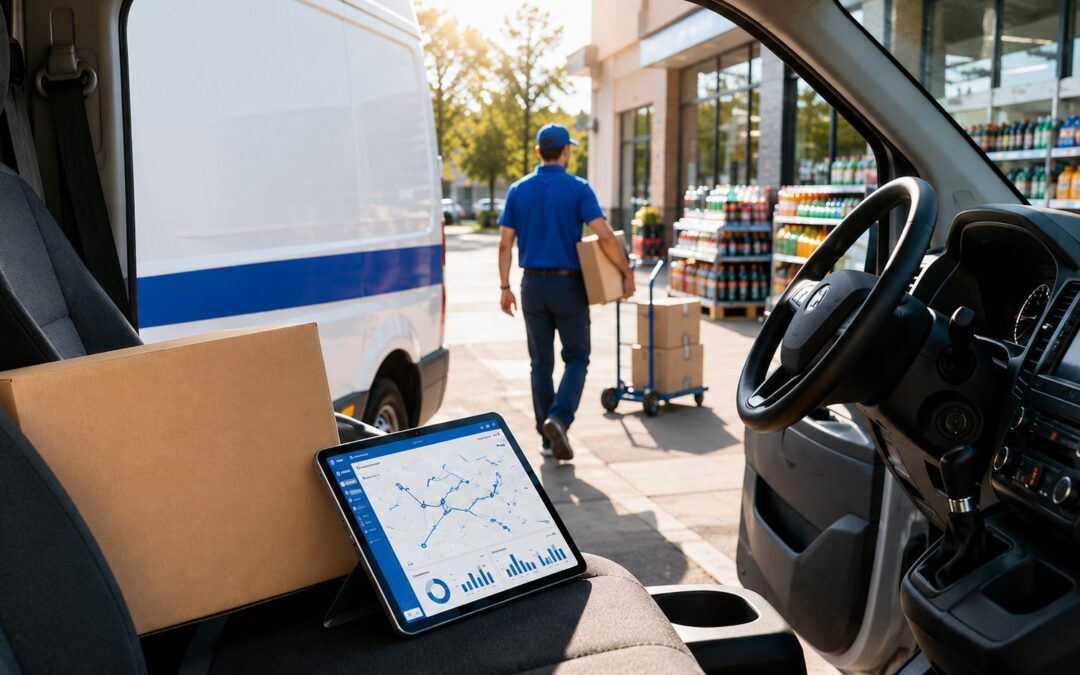
Direct Store Delivery for CPG: DSD Software Guide (2026)
Quick Answer
Direct store delivery for CPG is the distribution model where manufacturers deliver products directly to retail stores rather than through distributor warehouses. Modern DSD software transforms this traditional approach with AI-powered route optimization, real-time order capture, and integrated shelf execution — helping CPG brands like Coca-Cola and Nestlé reduce delivery costs by up to 22 percent while improving in-store availability. The global DSD software market is projected to reach $1.46 billion by 2026.
Introduction
Direct store delivery for CPG has powered the consumer goods industry for over a century — and for good reason. It puts products directly into stores faster than any other distribution model, a critical advantage for high-turnover categories like beverages, snacks, and dairy. Yet many CPG companies still manage DSD operations with pen-and-paper forms or disconnected mobile apps that create costly data gaps. Industry estimates suggest that the gap between analog DSD and modern digital systems costs the sector over $2.3 billion annually in lost sales from out-of-stocks and missed merchandising opportunities. Consequently, the question facing CPG commercial leaders is no longer whether to digitize direct store delivery for CPG, but how quickly they can deploy a unified DSD software platform. This guide covers the market opportunity, key capabilities of modern DSD software, implementation best practices, and how leading CPG brands are turning direct store delivery into a measurable growth engine.
Why Direct Store Delivery for CPG Remains the Gold Standard in Distribution
Direct store delivery for CPG represents the fastest route from production line to retail shelf. Unlike warehouse-to-distributor models that pass through multiple inventory touchpoints, DSD puts products directly into stores — typically within 24 to 48 hours of production. This velocity advantage is essential for categories where freshness matters and shelf space is fiercely contested.
Moreover, DSD gives CPG manufacturers direct control over in-store execution. When a DSD representative delivers products, they can simultaneously check shelf conditions, rotate inventory, set up promotional displays, and record competitor activity. This dual role — delivery plus retail execution — is what makes direct store delivery for CPG uniquely valuable. However, it also creates a data challenge: without digital tools, all that valuable in-store intelligence stays in the delivery driver’s notebook rather than flowing back to the commercial team.
McKinsey’s analysis of CPG sales operations highlights that companies with digitally enabled DSD teams achieve 2.3 times higher field productivity compared to those using traditional methods. The reason is straightforward — when delivery representatives capture orders, shelf conditions, and promotional compliance data through a single mobile platform, the business gains continuous, real-time visibility into what is actually happening at the store level.
The $1.46 Billion DSD Software Market in Direct Store Delivery for CPG
The business case for digitizing direct store delivery for CPG is reinforced by substantial market growth. According to Business Research Insights, the global DSD software market is projected to reach $1.46 billion by 2026, growing at a compound annual rate of 9.4 percent. This expansion is driven by two concurrent trends: the rise of direct-to-retail models in emerging markets with fragmented retail landscapes, and the adoption of AI-powered tools that dramatically increase the ROI of DSD digitization.
India, Indonesia, and Kenya lead global search volume for DSD-related keywords — all markets where CPG distribution networks span thousands of tiny retail outlets. In these environments, direct store delivery for CPG is not merely a distribution choice but a foundational operational necessity. The same markets are also early adopters of van sales software, which integrates DSD order capture with inventory management and payment processing.
How Modern DSD Software Solves the Route-to-Market Data Gap
Traditional direct store delivery for CPG relies on the delivery representative as the single point of data collection. While effective in theory, this creates systemic blind spots: orders are handwritten, delivery quantities go unrecorded, and van stock reconciliation is done manually at the end of each day. In addition, route planning is typically done manually or with basic GPS tools, leading to suboptimal visit sequences and excessive driving time.
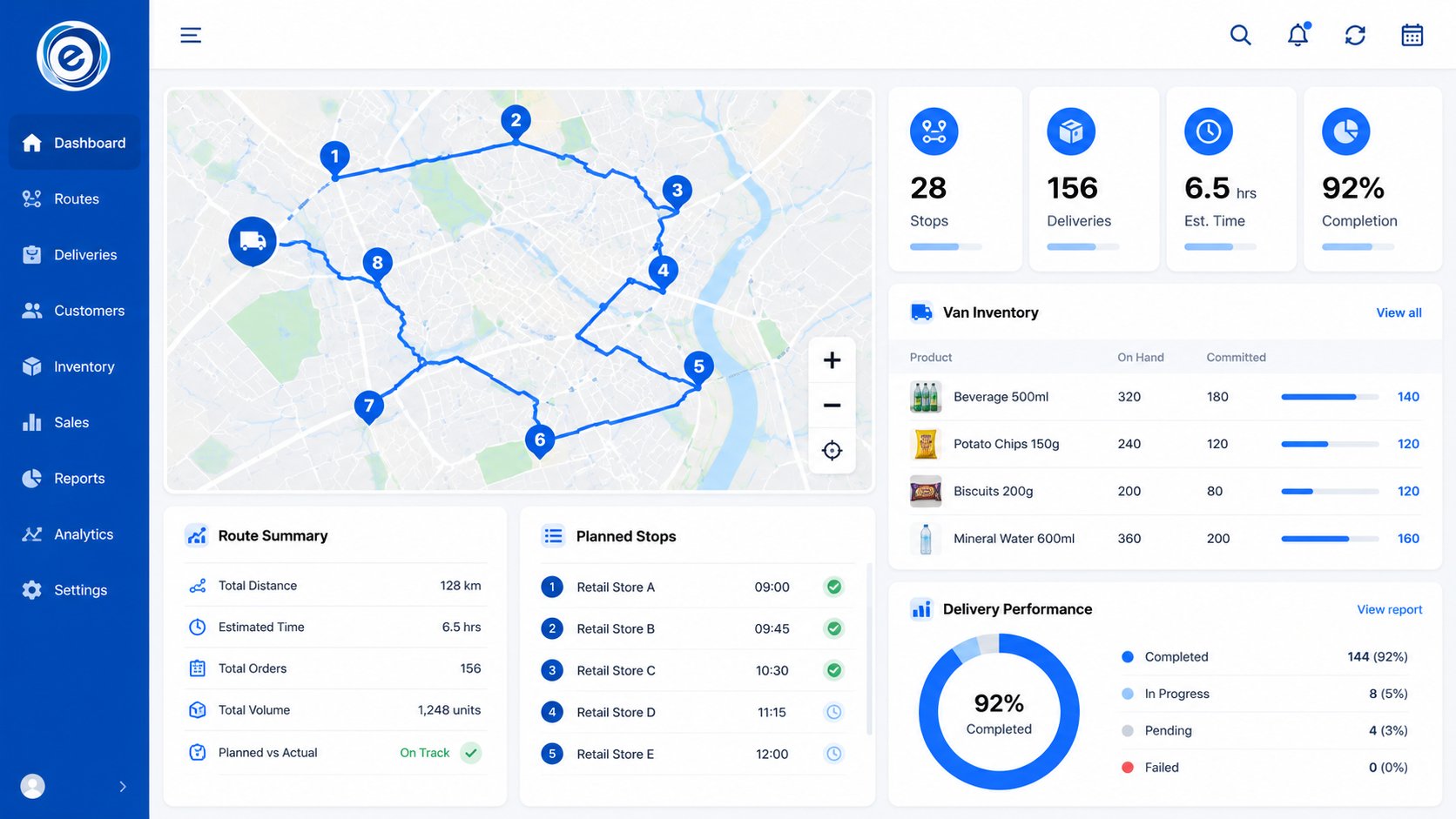
Modern DSD software addresses these gaps by digitizing every step of the delivery cycle. Route optimization uses AI algorithms to sequence store visits for maximum efficiency. Order capture becomes a real-time digital process with built-in upsell suggestions based on historical store performance. Van inventory is tracked in real time, giving drivers full visibility into remaining stock for each SKU. Delivery confirmations, including digital signatures and electronic proof of delivery, are captured automatically at each stop. As a result, CPG commercial teams receive continuous, route-level delivery intelligence rather than end-of-day reconciliation reports.
Key Capabilities of Modern DSD Software for Direct Store Delivery for CPG
Choosing the right DSD software platform is critical for CPG brands looking to maximize the return on their direct store delivery operations. The following capabilities differentiate modern platforms from basic mobile order-taking tools.
AI-Powered Route Optimization for DSD Fleets
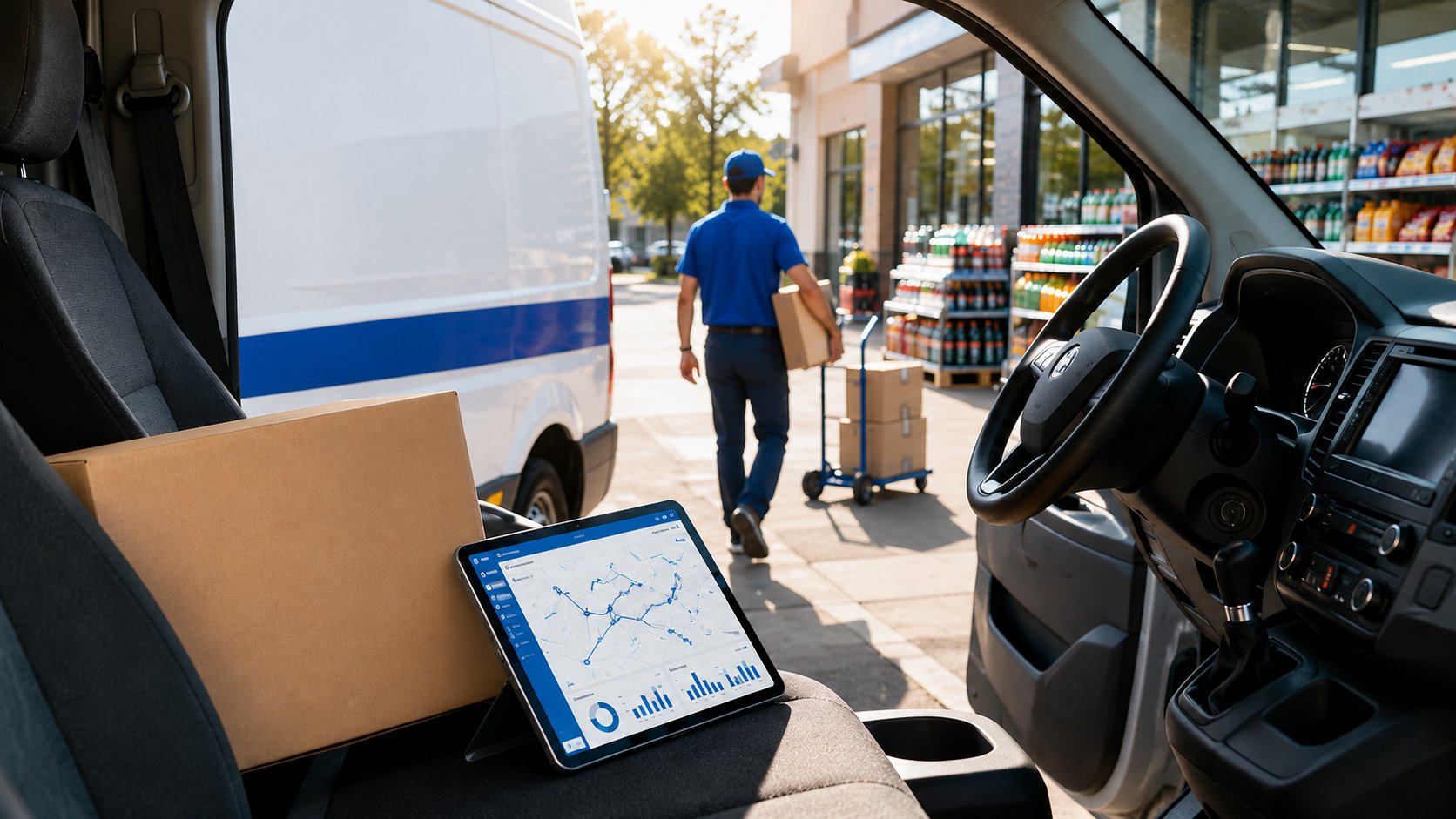
Route optimization is the highest-impact feature of modern DSD software. Rather than relying on driver experience or basic mapping tools, AI-powered route optimization analyzes multiple variables simultaneously — store opening hours, delivery windows, traffic patterns, vehicle capacity, and order priority — to generate optimal daily routes. The result is fewer miles driven, more stores visited per day, and lower fuel costs. On a national DSD fleet, the savings can reach seven figures annually.
Critically, AI route optimization is not a one-time planning exercise. The system learns from actual driving times, delivery durations, and road conditions to improve future route recommendations continuously. For CPG brands operating hundreds of DSD vehicles across diverse territories, this learning loop compounds over time, delivering progressively better route efficiency with each delivery cycle.
Digital Proof of Delivery and Van Stock Reconciliation
Real-time van stock management is a critical capability in modern DSD software. Every delivery van carries a dynamic inventory that changes throughout the day as products are delivered and returns are collected. Without digital van stock reconciliation, drivers lose visibility into what they still have available for the next stop, leading to missed sales opportunities or over-promising to retailers.
Modern DSD software solves this with real-time van inventory tracking. As a delivery representative completes each store stop, the system automatically deducts delivered quantities from the van’s digital inventory and adds any returned items. The driver sees an always-current stock count on the mobile device, with instant visibility into which SKUs are running low before arriving at the next store. At the end of the day, automated reconciliation compares the initial van load against delivered quantities, returned items, and remaining stock — eliminating manual counting and the reconciliation errors that traditionally consume hours of driver and supervisor time each week.
Van Sales Integration and Mobile Order Capture
Van sales is the operational heart of direct store delivery for CPG. The delivery vehicle functions as a mobile sales point: the representative stocks products from the van, captures orders on a mobile device, issues invoices, and collects payments — all at the store location. Modern DSD software streamlines this entire workflow with offline-capable mobile order capture, real-time inventory sync, and integrated payment processing.
The key technical requirement for van sales software is offline reliability. DSD routes frequently pass through areas with limited or intermittent cellular connectivity. A robust DSD platform must support full offline functionality on the mobile app — order capture, product lookup, pricing, and customer history — with automatic synchronization once connectivity is restored. Without this capability, van sales operations remain vulnerable to data loss and processing delays.
How eBest Transforms Direct Store Delivery for CPG
eBest Mobile provides a unified platform purpose-built for direct store delivery for CPG operations. The eBest DSD module integrates AI route optimization, mobile order capture, van stock tracking, and real-time delivery confirmation into a single application used by delivery representatives in the field. What sets eBest apart is the seamless connection between DSD and the broader SFA ecosystem — the same platform that manages field sales, distributor relationships, and trade promotion execution also powers the direct store delivery operation.
The results are measurable. Coca-Cola, the quintessential DSD company operating in over 200 countries and delivering to more than 25 million retail outlets daily, has deployed eBest’s integrated SFA-DSD platform to streamline route planning, order capture, and delivery processing in a single field visit. The integration eliminates the dual-system overhead that plagues many CPG DSD operations — delivery representatives using separate tools for routing, order taking, and inventory reporting.
For CPG sales directors evaluating DSD technology, the message is clear: modern direct store delivery for CPG requires more than a route planning app. It demands an integrated platform that unifies delivery execution, van inventory management, and real-time sales data. Explore how eBest’s SFA software for CPG integrates with DSD operations, or learn how trade promotion optimization becomes more effective when delivery teams have real-time visibility into promotional stock movements. Browse our client success stories to see how global CPG brands are transforming DSD performance.
Frequently Asked Questions
Q1: What is direct store delivery for CPG?
Direct store delivery for CPG is a distribution model where manufacturers deliver products directly to retail stores instead of shipping to distributor warehouses. It is commonly used for high-turnover categories such as beverages, snacks, dairy, and bakery products where freshness and shelf availability are critical. DSD gives manufacturers direct control over order quantities, shelf presentation, and promotional execution at each store. Leading CPG brands including Coca-Cola, PepsiCo, and Nestlé rely on DSD as their primary distribution model for priority categories. The model is particularly dominant in beverages — over 70 percent of carbonated soft drinks in the United States reach consumers through direct store delivery.
Q2: How does DSD software improve direct store delivery for CPG operations?
DSD software digitizes every aspect of direct store delivery for CPG, replacing manual processes with automated, data-driven workflows. Route optimization algorithms reduce driving time and fuel costs by sequencing store visits based on traffic patterns, delivery windows, and order volumes. Mobile order capture eliminates paper invoices and manual data entry errors. Real-time van inventory tracking ensures the delivery vehicle carries the right stock for each stop. Digital proof of delivery automates the confirmation process and captures signatures electronically. Together, these capabilities typically reduce DSD operational costs by 15 to 25 percent while simultaneously improving in-store availability and delivery accuracy.
Q3: How does AI improve route optimization for CPG DSD fleets?
AI improves route optimization for CPG DSD fleets by analyzing multiple variables that manual planning cannot handle at scale. The AI engine considers store operating hours, delivery time windows, traffic patterns, road conditions, vehicle capacity, and order priority to generate optimal daily routes. Unlike static route planning, AI-powered optimization learns from actual driving times and delivery durations — continuously improving route recommendations over time. For large CPG DSD operations with hundreds of vehicles and thousands of stores, the compound savings are substantial. Gartner’s Market Guide for Retail Execution identifies route optimization as a top-three capability for improving field sales productivity, and NielsenIQ’s retail analytics confirm that optimized DSD routes reduce out-of-stocks by an average of 18 percent.
Q4: What is the difference between DSD software and van sales software?
DSD software and van sales software serve overlapping but distinct functions. DSD software covers the full direct store delivery lifecycle — route planning, order capture, delivery confirmation, shelf compliance, and returns management. It is designed for manufacturer-owned distribution fleets. Van sales software is a subset of DSD focused specifically on the mobile selling workflow: a delivery representative carries inventory in the vehicle, sells products store by store, and completes transactions on the spot. Van sales software typically includes order capture, invoicing, payment collection, and basic inventory management, but may not include advanced route optimization, shelf analytics, or trade promotion integration. For CPG brands with dedicated DSD fleets, investing in comprehensive DSD software rather than basic van sales tools delivers significantly higher long-term value through unified operational intelligence.
Q5: How do I choose the right DSD software for my CPG brand?
Choosing the right DSD software for your CPG brand requires evaluating six key criteria. First, confirm the platform is purpose-built for CPG DSD rather than adapted from general logistics software — SKU-level tracking, shelf compliance, and trade promotion integration are essential. Second, verify offline mobile functionality — DSD routes often cross areas with poor connectivity, and the mobile app must work without internet access. Third, evaluate AI route optimization quality — ask for benchmark data showing route efficiency improvements from existing deployments. Fourth, check integration with your existing SFA or DMS — a unified SFA-DSD platform eliminates the data silos that undermine ROI. Fifth, examine implementation track record with CPG brands at your scale, especially in your operating regions. Sixth, review the platform’s analytics capabilities — can it generate the shelf compliance, route efficiency, and delivery performance reports your commercial team needs? Prioritize platforms that offer a complete suite rather than point solutions, as integration complexity is consistently the top barrier to successful DSD digitization.
Conclusion
To summarize, direct store delivery for CPG is undergoing a digital transformation that promises significant competitive advantage for early adopters.
- Modern DSD software with AI route optimization reduces delivery costs by 15 to 25 percent while improving store-level availability.
- Integrated shelf compliance analytics turn every DSD delivery into a retail audit, eliminating duplicate merchandiser visits.
- A unified SFA-DSD platform gives CPG brands end-to-end visibility from route planning to in-store execution in a single system.
Ready to transform your CPG direct store delivery operations? Explore eBest DSD software or book a demo to see how Coca-Cola, Nestlé, and Carlsberg are already achieving measurable DSD performance gains.
Ready to Digitize Your Route to Market?
Learn how eBest’s integrated SFA, DMS, and TPM platform helps leading CPG brands turn distribution data into competitive advantage.