

Distributor Management System for CPG: 5 Ways to Boost ROI
Quick Answer
A distributor management system for CPG gives commercial teams real-time visibility into secondary sales — the critical data showing what distributors actually sell to retailers. Without it, CPG companies operate blind, losing an estimated $82 billion annually to supply chain inefficiencies. Modern DMS platforms combine real-time inventory tracking, AI-powered demand prediction, automated order workflows, and field sales integration to transform distribution from a cost center into a measurable growth engine.
Introduction
Most CPG companies can tell you exactly what shipped from their warehouse. However, what happens after products reach the distributor remains a black box for many organizations. A distributor management system for CPG solves this by giving brand owners real-time visibility into secondary sales, distributor inventory levels, and retail execution performance across every outlet in their network. Moreover, with industry data showing that CPG companies lose $82 billion annually to supply chain gaps — distributor blind spots ranking among the top three causes — the cost of inaction has never been higher. This article walks through five concrete, measurable ways a modern distributor management system for CPG boosts distribution ROI, from eliminating stock-outs to integrating field sales data for a unified commercial view. In addition, we share how leading CPG brands including Nestlé and Danone have turned distribution data into measurable competitive advantage.
Why CPG Companies Need a Distributor Management System for CPG
Traditional distributor management relies on spreadsheets, monthly email reports, and phone calls to regional distributors. Consequently, brand owners receive sales data anywhere from three to ten days after transactions occur. In fast-moving consumer goods, a seven-day reporting lag means stock-outs go undetected for an entire replenishment cycle. Furthermore, manual reporting invites errors — distributors may under-report sales to negotiate better margins, or simply lack the digital infrastructure to provide accurate, SKU-level data.
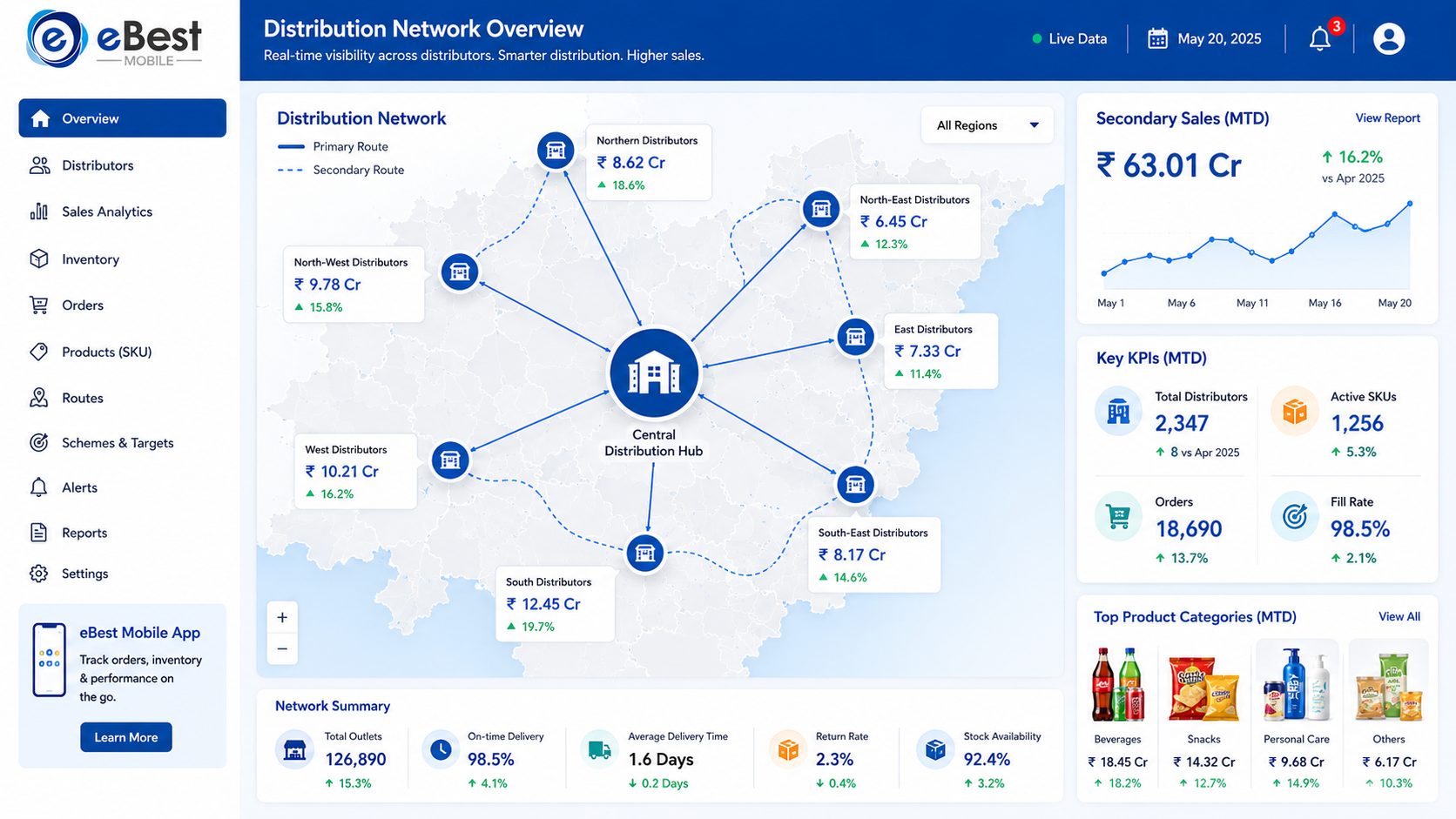
A distributor management system for CPG addresses these challenges head-on by digitizing the entire secondary sales chain. Rather than waiting for monthly distributor statements, commercial directors access real-time dashboards showing which SKUs are moving, at which retail outlets, at what price, and with what promotional support. This shift from reactive to proactive distribution management changes the economics of route-to-market strategy. As a result, CPG companies with integrated DMS platforms report 2.3 times higher field representative productivity compared to those relying on siloed systems, according to McKinsey’s analysis of CPG sales operations.
Additionally, the market context demands this capability. India leads global search volume for distributor management system keywords at 32% of all queries, followed by Southeast Asian markets including Indonesia and the Philippines. These are precisely the regions where CPG distribution networks are most fragmented — a single brand may work with 500 to 15,000 distributors across dozens of states and provinces. Without a unified platform, managing distributor relationships at this scale is nearly impossible.
The Hidden Cost of Distributor Blind Spots in CPG
The financial impact of limited distributor visibility extends far beyond missed sales. First, stock-outs at the distributor level cascade directly to retail shelves — a product that never reaches the distributor cannot reach the consumer. Second, excess distributor inventory ties up working capital that could fund trade promotions or new product launches. Third, without secondary sales data, CPG companies cannot accurately measure trade promotion ROI, because they lack visibility into whether promoted stock actually sold through to retailers or simply sat in distributor warehouses.
Gartner’s Market Guide for Retail Execution and Sales Force Automation identifies “real-time secondary sales data” as the number one unmet need for CPG commercial leaders in 2026. In other words, the industry recognizes the problem — but most technology solutions still treat distributor visibility as an afterthought rather than a core platform capability. As a consequence, CPG brands that invest in a dedicated distributor management system for CPG gain a first-mover advantage that compounds with network scale: the more distributors onboarded, the more granular and predictive the data becomes.
5 Ways a Distributor Management System for CPG Boosts Distribution ROI
The core value proposition of a distributor management system for CPG is straightforward — transform distribution from a black-box cost center into a data-driven profit driver. Below, we examine five specific mechanisms through which modern DMS platforms deliver measurable return on investment, supported by industry benchmarks and real-world case data.
Real-Time Secondary Sales Visibility
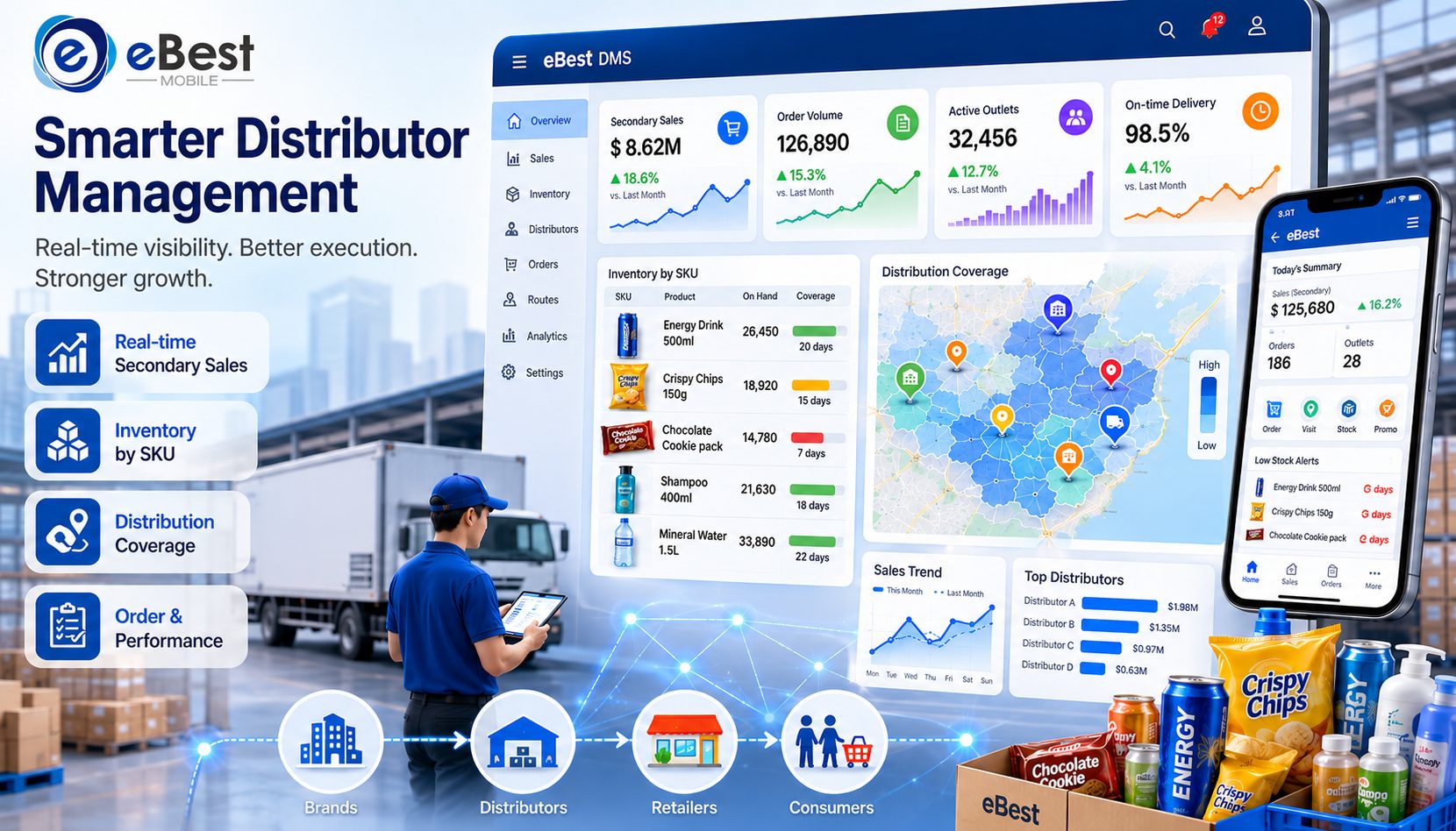
The foundation of any effective distributor management system for CPG is real-time secondary sales data. Instead of receiving aggregated monthly spreadsheets, commercial teams see exactly which SKUs each distributor sold to which retailer, at what price, and on what date — updated continuously. This visibility enables brands to detect regional demand shifts within hours rather than weeks. For instance, if a particular beverage SKU spikes in one state while declining in another, the sales director can rebalance distributor allocations immediately rather than waiting for the next planning cycle. The result is fewer stock-outs, lower lost sales, and distributor inventory turns that improve by 15 to 25 percent within the first year of deployment.
AI-Powered Inventory Prediction for Distributors
Beyond real-time visibility, the most advanced distributor management system for CPG platforms now incorporate artificial intelligence to predict inventory needs before shortages occur. The AI analyzes historical sales patterns, seasonal trends, upcoming promotions, and even external factors like weather forecasts and local holidays to recommend optimal stock levels per SKU per distributor. This capability is particularly valuable in emerging markets where demand patterns are less predictable and distributor networks span thousands of outlets. Consequently, CPG brands using AI inventory prediction within their DMS reduce stock-out incidents by 30 percent or more while simultaneously lowering excess inventory carrying costs. The dual benefit — higher sales with lower working capital — directly improves distribution ROI.
Automated Order Workflow and Compliance Tracking
Manual distributor order processing introduces errors, delays, and reconciliation headaches that consume commercial team bandwidth. A modern distributor management system for CPG automates the entire order-to-cash workflow: distributors place orders through a mobile app or web portal, the system validates pricing and promotion terms automatically, and order confirmations flow directly to logistics teams. Meanwhile, built-in compliance tracking ensures distributors adhere to agreed planogram standards, pricing guidelines, and promotional calendars. Carlsberg, for example, uses integrated DMS functionality to enforce planogram compliance across more than 8,000 distribution points, significantly improving brand consistency at retail. When distributors know their performance is tracked against clear KPIs, compliance rates rise and commercial teams can focus on growth rather than policing.
How eBest Delivers Measurable Distribution ROI
eBest Mobile provides a unified distributor management system for CPG that goes beyond basic secondary sales tracking. The platform combines real-time distributor data with field sales automation — meaning field representatives see live distributor stock levels during store visits through the same mobile application they use for order taking and retail execution audits. This unified approach eliminates the data fragmentation that occurs when a brand’s SFA and DMS operate as separate systems. Furthermore, eBest’s AI sell-in suggestion engine analyzes distributor-level demand patterns to recommend optimal order quantities per SKU, factoring in historical consumption, seasonality, and promotional calendars.
The results speak through real deployments. Nestlé, managing over 15,000 distributors across emerging markets, reduced stock-out rates by 31 percent after deploying eBest’s integrated DMS and SFA platform. Secondary sales reporting shifted from T+7 — seven days after transaction — to real-time, giving commercial leaders immediate visibility into market conditions. Similarly, Danone unified its distributor management system for CPG with field sales operations, cutting distributor onboarding time by 60 percent and accelerating time-to-revenue in new territories.
For CPG sales directors evaluating digital transformation priorities, the message is clear: a distributor management system for CPG is not a back-office utility — it is a front-line growth engine. Explore how eBest’s SFA software for CPG integrates with real-time distribution data, or learn how trade promotion optimization becomes more effective when powered by secondary sales visibility. Browse case studies to see how global CPG brands are transforming distribution performance with eBest.
Frequently Asked Questions
Q1: What is a distributor management system for CPG?
A distributor management system for CPG is a software platform that gives consumer packaged goods companies real-time visibility into what their distributors sell to retailers — known as secondary sales. Unlike traditional methods that rely on monthly spreadsheet reports from distributors, a modern DMS captures SKU-level sales data, inventory positions, and order workflows through a digital platform. Moreover, the most effective systems integrate AI-powered demand forecasting, automated order processing, and field sales data to create a unified view of distribution performance. For CPG brands managing hundreds or thousands of distributors, the platform replaces guesswork with data-driven decision-making. Leading CPG companies including Nestlé, Unilever, and Danone have deployed distributor management systems to reduce stock-outs, improve trade promotion ROI, and accelerate revenue growth across fragmented distribution networks.
Q2: How does a distributor management system improve distribution ROI?
A distributor management system improves distribution ROI through five primary mechanisms. First, real-time secondary sales data eliminates the reporting lag that causes undetected stock-outs and lost revenue. Second, AI-powered inventory prediction ensures optimal stock levels per distributor, reducing both shortages and excess carrying costs. Third, automated order workflows cut processing time and eliminate manual errors that create costly reconciliation work. Fourth, built-in compliance tracking enforces planogram standards and promotional guidelines across every distribution point. Fifth, integration with field sales automation gives representatives complete visibility during store visits — they see distributor stock levels and can adjust orders on the spot. Together, these capabilities typically deliver a distribution ROI improvement of 15 to 30 percent within the first year, with the fastest returns coming from stock-out reduction and secondary sales acceleration.
Q3: How does AI improve distributor inventory management for CPG companies?
AI transforms distributor inventory management by moving from reactive replenishment to predictive demand planning. Specifically, AI models analyze multiple data streams — historical sales by SKU and region, seasonal consumption patterns, upcoming trade promotion calendars, and external signals like local events or weather data from NielsenIQ’s retail analytics — to predict exactly how much stock each distributor needs for the coming period. This prevents both stock-outs and overstock situations simultaneously. In addition, AI-powered sell-in suggestions recommend optimal order quantities per SKU to each distributor, factoring in their individual sales velocity and market conditions. For CPG brands with large distributor networks, the compound effect is substantial: Nestlé reported a 31 percent reduction in stock-out rates and significantly improved secondary sales reporting after deploying AI-enabled distributor management technology across 15,000 distribution points.
Q4: What is the difference between a DMS and an ERP system for CPG companies?
While both systems manage business data, they serve fundamentally different purposes in a CPG context. An ERP (Enterprise Resource Planning) system manages internal operations — production planning, financial accounting, procurement, and primary sales from the brand’s own warehouse. In contrast, a distributor management system for CPG focuses on external distribution — tracking what happens after products leave the brand’s warehouse and enter the distributor network. The ERP tells you what you shipped; the DMS tells you what actually sold through to retailers. Consequently, the two systems are complementary rather than substitutes. Most CPG companies run both, integrating their DMS with the ERP to create a complete picture from production through to retail sell-through. The key distinction: ERP visibility ends at the factory gate, while DMS visibility extends to the retail shelf.
Q5: How do I choose the right distributor management system for my CPG brand?
Choosing the right distributor management system for CPG operations requires evaluating five key criteria. First, assess whether the platform is purpose-built for CPG or is a generic distribution tool adapted for the industry — CPG-specific features like SKU-level tracking, trade promotion integration, and planogram compliance are essential. Second, verify that the DMS integrates natively with your field sales automation tools, since disconnected systems create data silos that defeat the purpose. Third, examine the AI capabilities — does the system offer predictive inventory forecasting and automated sell-in recommendations? Fourth, evaluate mobile accessibility for distributors, particularly in emerging markets where desktop infrastructure may be limited. Fifth, review implementation track record with CPG brands at your scale — ask for case studies showing measurable ROI metrics like stock-out reduction and secondary sales visibility improvement. Finally, prioritize platforms that offer a unified SFA plus DMS experience, as integration complexity is consistently the top barrier to successful deployment.
Conclusion
To summarize, a distributor management system for CPG is no longer optional for brands competing in fragmented, distributor-heavy markets.
- Real-time secondary sales visibility eliminates the reporting lag that costs CPG companies billions in missed revenue annually.
- AI-powered inventory prediction prevents stock-outs and overstock simultaneously, delivering dual ROI from higher sales and lower working capital.
- A unified DMS plus SFA platform gives field representatives complete distributor context during every store visit.
Ready to transform your CPG distribution performance with real-time data? Explore eBest DMS or book a consultation to see how Nestlé, Danone, and Carlsberg are already achieving measurable distribution ROI.
Ready to Transform Your Distribution Network?
Discover how an AI-powered distributor management system can help your CPG company eliminate stock-outs, optimize inventory across multi-tier networks, and protect revenue.